
National Instruments Releases New High-Performance Servo Drives and Motors

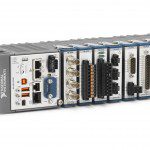
National Instruments announces new AKD Servo Drives and AKM Servo Motors that make it possible for engineers and scientists to easily build scalable, distributed motion control systems. The new products simplify setup and configuration for deploying custom motion applications to any NI real-time controller supporting NI EtherCAT technology including NI CompactRIO, PXI real-time controllers and NI industrial controllers. Additionally, National Instruments is releasing the NI LabVIEW 2010 NI SoftMotion Module that provides support for NI EtherCAT drives for simplified motion application development.

The new AKM brushless servo motors provide superior dynamic performance, are available in four different frame sizes and feature high torque, density and speed ranges. The motors use low-inertia rotors and feature low-cog, low-harmonic distortion magnetic design. The motors also are perfectly matched with NI servo drives and provide plug-and-play configuration with integrated Smart Feedback Device (SFD) technology and simplified cabling.

The new AKD Servo Drives feature simplified setup and configuration through EtherCAT technology and integration with the LabVIEW project, a feature in LabVIEW software that engineers use to group together LabVIEW and third-party files, create build specifications for executables and deploy or download files to hardware targets. The new drives deliver cutting-edge technology and performance with torque loop updates in 0.67 μs, and velocity and position loops at 62.5 μs and 125 μs. The AKD Servo Drives provide a solution for a wide range of applications, from basic torque-and-velocity applications to indexing to multi-axis programmable motion, using graphical system design.

The new motors and drives provide seamless integration with LabVIEW graphical programming through the LabVIEW NI SoftMotion Module to deliver graphical development for custom motion control applications. With the module, engineers and scientists can use the LabVIEW project to configure motion axis settings, test configuration, tune motors and quickly develop a custom motion application. The new version of the NI SoftMotion Module features an updated interactive configuration and a high-level function block API for increased ease of use and makes the execution of motion applications on a Windows-based system possible. In addition, the new module easily connects to the new drives and motors as well as third-party drives and motors using NI C Series drive interface hardware.

Readers can visit www.ni.com/motion to learn more about the new servo drives and motors and NI motion control software.

National Instruments
www.ni.com

National Instruments introduces latest products for connecting NI LabVIEW to Industrial Networks

National Instruments (www.ni.com) is proud to announce the release of new interfaces for DeviceNet, PROFIBUS and FOUNDATION Fieldbus that allow industrial control engineers to connect embedded systems, LabVIEW and programmable automation controllers (“PACs”) to existing industrial networks. The latest interfaces give engineers the ability to add advanced control, high-speed measurements and analysis, data logging and Web connectivity to existing applications so as to improve the quality and performance of their machines. The latest NI CompactRIO PROFIBUS C Series modules connect NI Single-Board RIO and CompactRIO to PROFIBUS DP networks as slaves or masters, which add custom control and high-performance measurements to systems that have been standardized on PROFIBUS. National Instruments also announced the new one-port FOUNDATION Fieldbus H1 interface for USB, as well as a pair of DeviceNet master boards for PCI and PXI.

Currently, PROFIBUS has over 30 million installed nodes around the world and is a leader in industrial networks for connecting programmable logic controllers (“PLCs”), drives, sensors and I/O in automation and industrial systems. The new C Series modules can make it possible to connect NI Single-Board RIO and CompactRIO PACs embedded systems to PROFIBUS industrial network and add custom field-programmable gate array (“FPGA”) logic, high-performance measurements and advanced analysis to existing systems. Engineers now can easily retrofit and upgrade existing systems and machines by using the new PROFIBUS modules to quickly add LabVIEW graphical software and flexible, high-performance NI hardware to accomplish custom and high-speed tasks that traditional PLCs cannot solve.

Foundation Fieldbus is a two-way digital communication protocol normally used in process automation. The latest NI USB-8486 is a one-port FOUNDATION Fieldbus H1 interface that gives data control, logging and configuration in distributed control system and HMI applications.

National Instruments Simplifies Advanced Motion Control

National Instruments announces the new LabVIEW NI SoftMotion Module, which simplifies the development of advanced single- and multi-axis motion applications, and new NI C Series modules, which expand the connectivity of the NI CompactRIO programmable automation controller (PAC) platform to hundreds of servo and stepper drives from NI and third-party vendors. These two additions to the NI family of motion products combine the ease of use and I/O capabilities of NI LabVIEW graphical programming with the customization and synchronization benefits of field-programmable gate array (FPGA)-based CompactRIO hardware to deliver an ideal platform for developing advanced motion applications.

LabVIEW NI SoftMotion offers the convenience of programming motion profiles with a high-level, function block API based on the Motion Control Library defined by PLCopen. It includes function blocks for straight line, arc and contoured move types as well as function blocks for advanced operations such as electronic gearing and camming. The module also features advanced functions for designing custom motion applications including trajectory generation, spline interpolation, position and velocity control and encoder implementation. Because the module is an extension of LabVIEW, engineers and scientists easily can synchronize their motion applications with I/O and measurements in a single development environment.

LabVIEW-NI-SoftMotion-Module.jpg

LabVIEW NI SoftMotion seamlessly integrates with CompactRIO to deliver an ideal solution for advanced motion control applications. Using the new C Series drive interface modules, engineers and scientists can take advantage of a CompactRIO feature that automates FPGA programming to easily integrate FPGA benefits such as reliable, high-speed control and synchronization into their applications. Additionally, LabVIEW NI SoftMotion works with customized axes for engineers and scientists who want to use third-party hardware.

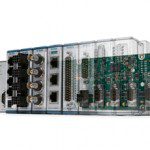
With direct connectivity to hundreds of servo and stepper drives, the new C Series drive interface modules make it easy to incorporate new or existing motors and drives into motion systems. The NI 9512 module connects to stepper drives and motors, while the NI 9514 and NI 9516 modules feature single- and dual-encoder feedback, respectively, and interface with servo drives and motors. Because motion applications tend to be processing-intensive, the drive interface modules perform onboard processing to free up processing power and increase performance. Additionally, the drive interface modules work with the NI 9144 deterministic Ethernet expansion chassis, which features two Ethernet ports that make it possible to daisy-chain multiple chassis from a CompactRIO, the NI 3100 industrial controller or a real-time PXI controller to create distributed motion applications.

Readers can visit www.ni.com/motion to learn about NI motion control products as well as read case studies and download white papers on how NI technology can be used for motion applications.

National Instruments
www.ni.com

Industry’s First 3U Quad-Core PXI Controller

February 27, 2009 by Motion Control Tips Editor  
Filed under Controllers

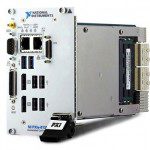
National Instruments introduces the NI PXI-8110 embedded controller, which is the industry’s first 3U quad-core embedded controller for PXI systems. Featuring a 2.26 GHz Intel® Core™2 Quad processor Q9100, up to 4 GB 800 MHz DDR2 RAM and a high-performance 7200 rpm drive, it is also the industry’s fastest embedded controller in the 3U PXI class. The PXI-8110 provides an up to 80 percent performance improvement over dual-core controllers with similar CPU clock frequencies for applications that are optimized to use the controller’s four processing cores.

ni-pxi-controller.jpg

Computer processor manufacturers are continuing to add more CPU cores to their processors as a way of enhancing computing power. When using traditional text-based programming languages, engineers who want to harness this computing power for developing advanced test, measurement and control applications regularly face the challenges of using complex software primitives and programming models. However, engineers and scientists can capitalize on multi-threaded application development by combining the multicore support and parallelism of National Instruments LabVIEW graphical system design software with the PXI-8110 controller’s advanced functionality. Because the new controller features a platform on which an application can distribute processing loads across four CPU cores simultaneously, it can significantly reduce test times for applications that require intensive signal and data processing such as RF protocol testing and hardware-in-the-loop (HIL) simulations. These applications also can replicate specific tests or processes to run on separate CPU cores and effectively double system throughput.

As an example of its leading-edge performance, the PXI-8110 can process up to 215,000 1K fast Fourier transforms (FFTs) per second, which is approximately 80 percent faster than the NI PXI-8108 dual-core embedded controller. Previously, this type of performance could be achieved only by using a bulky workstation. The PXI-8110 offers this same capability in a compact, 3U form factor that fits seamlessly inside a PXI chassis.

The PXI-8110 also is available in a version that supports the NI LabVIEW Real-Time and LabWindows™/CVI Real-Time modules to deliver a flexible and rugged platform for deterministic and real-time measurement and control. With dual-core real-time systems, engineers are limited to a single CPU core to execute time-critical application segments because the other core is used for executing noncritical background services. With the new PXI-8110 quad-core embedded controller, engineers can allocate multiple CPU cores for running time-critical test sections while delegating noncritical services to the remaining cores. This capability helps engineers create powerful real-time and deterministic systems.

www.ni.com/pxi