
Fast Piezo Focusing Systems presented at BIOS
January 27, 2011 by Motion Control Tips Editor
Filed under Controllers, Sensors/Vision
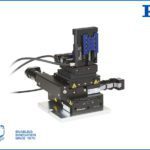
Physik Instrumente (PI) L.P. (www.physikinstrumente.com) proudly introduces a more affordable series of Fast Piezo Focusing devices at the 2011 BIOS (Biomedical Optics) conference held together with SPIE’s Photonics West.
The latest PIFOC system packages are developed to improve results in lens positioning and fast focusing including deconvolution / 3D imaging, as well as to minimize costs.
The PIFOC piezo objective scanner system packages comprise custom-tuned compact digital servo controller / driver units and closed-loop piezomechanic objective positioners. The duo provides reduced costs with higher performance. The frictionless and high-stiffness piezo flexure drive integrated in the system ensures short settling times and quick response, as well as outstanding guiding accuracy. The settling time of not more than 10ms increases throughput and allows for fast Z-stack acquisition.
The digital controller delivers several advantages than the fast focusing systems of conventional analog controllers currently available. These include improved settling performance, higher linearity, access to advanced automation features and quick adaptation to varying motion requirements.
The integrated software allows switching of various sets of parameters on-the-fly and facilitates system setup. For the user, this means always getting the maximum performance from the piezo focusing mechanism. System integration becomes much more straightforward without the need of accessing trim pots and jumpers to make changes.
System setup with the integrated user-interface software is easy and fast, and interfacing to the customers’ software is made easier with the DLLs and LabVIEW drivers. Drivers for image acquisition software packages such as µManager and MetaMorph are also available.
M-272 linear actuator based on maintenance-free ultrasonic motor technology
January 18, 2011 by Motion Control Tips Editor
Filed under Actuators, Linear Motion
Piezo motor specialist PI (www.pi-usa.us) proudly launches its latest line of linear actuator, the M-272 linear actuator or automation applications. It is maintenance-free as it is based on PILine ultrasonic ceramic motor.
PILine ultrasonic piezo drives provide an affordable substitute to motor-leadscrew combinations and electromagnetic linear motors when small dimensions and/or high speed are important. These drives are compact, fast and are readily integrated; offering velocities of up to 200 mm/s. PIline motors do not need additional motor brake as they are self-locking when at rest.
The new M-272 closed-loop linear drive combines linear encoder, guiding system, motor, brake and actuator functionality in a compact package. Its integrated guiding system enables users to position and attach the payload easily to M-272’s drive rod.
PILine piezo motors are based on a patented and ultrasonic drive principle by PI. The system’s main piece is a piezoceramic plate, which is excited with high-frequency eigenmode oscillations. A friction tip is attached to the plate, which moves at eigenmode frequency along inclined linear path. The moving part of the mechanical system is pushed by the ceramic friction bar or runner. The mechanical system is designed to execute at few nanometers only for every oscillatory cycle, resulting in a smooth motion with nearly unlimited travel range. Preloaded against the runner, the piezo ceramic plate is the holding force when the drive is not moving. The technology is protected under German Patent No. 10154526 and US Patent No. 6,765,335.
PROFINET completes Process Automation application profile
December 31, 2010 by Motion Control Tips Editor
Filed under Networks
PROFIBUS & PROFINET International (www.profibus.com) has reached another milestone for PROFINET, after the completion of the PROFINET for the Process Automation application profile. Thus, PROFINET is now ideally suited for both process and manufacturing automation, said PI.
Process automation has strict requirements for availability and reliability. For instance, plants are required to operate 24/7, 365 days a year with no interruption, and this must be sustained to make improvements in the production process. The causes of errors should be identified immediately, irrespective of the complexity of the actuators and sensors used. Other challenges include the large number of signals in the plant – usually number up to 100,000.
These requirements identified four main aspects that were integrated in the new profile: configuration in run; integration of existing fieldbuses; scalable redundancy; and time synchronization and time stamping.
Manufacturers can now implement these functions in their PROFINET products for process automation applications.
Important basic mechanisms underlying the “PROFINET for Process Automation’ application profile are already in the PROFINET Specification V2.3, which was released just in time for SPS/IPC/DRIVES 2010 in November. Aside from the new process automation-relevant specifications, the PROFINET Specification’s new version also includes specifications for high performance.
Physik Instrumente’s new C-867 equipped with piezo linear motor drives
November 4, 2010 by Motion Control Tips Editor
Filed under Actuators, Controllers, Motors, Piezo Motors
Physik Instrumente L.P. (www.physikinstrumente.com) has unveiled its all-new C-867 – a two-axis digital controller used for actuators, microscope stages, micropositioning systems and ultrasonic high-stability piezo motor stages like those used on the newest generation microscopes.
The new C-867, which is optimized for piezo linear motors, features integrated drive electronics for ultrasonic motors; dynamic servo parameter switching for faster settling; 4+4 programmable transistor-transistor logic inputs/outputs; RS-232, USB and joystick interfaces; daisy-chain networking for up to 16 axes; a data recorder and macro programming language; and extensive software support, including dynamic link library and LabView.
A compact case comprises components for controlling/communication and drive electronics for the piezo ceramic motors. The PIMikroMove user software features the PITuningTool for optimizing system performance.
This motor controller is made for closed-loop micropositioning systems integrated with piezo linear motor drives. The controller can be operated from an RS-232 interface or a host PC via a USB port. Stand-along operation can be done by joystick or through preprogrammed macro commands.
Maximum output voltage per channel is 200V, while maximum output power per channel is 15W. Operating temperature ranges between 5°C and 40°C, while operating voltage is 24VDC from an included external power supply.
The self-locking and nonmagnetic ultrasonic ceramic motors provide better positional stability compared to conventional magnetic linear motors or motor/leadscrew drives, according to Physik.
The all-new C-867 can be used in applications such as microscopy, biotechnology, automation, fiber positioning, quality assurance testing, photonics/integrated optics and testing equipment.
Physik introduces new piezo stepping drives
June 22, 2010 by Motion Control Tips Editor
Filed under Drives, Stepper Drives
Physik Instrumente (www.physikinstrumente.com) has unveiled its new piezo stepping drives, which can be combined with a linear encoder for nanometer accuracy over the complete scanning range. The new drives are available for PIFOC focusing systems for microscope objectives.
The N-725 PIFOC scanner for microscope objectives with NEXACT piezo stepping drives offers travel ranges of up to 1mm along the optical axis. The N-725’s focusing system can achieve transient times of up to 20ms for steps of 200NM. It has a compact design and is no larger compared to conventional, piezo-based PIFOC objective stages.
The focal plane can be changed with a single mechanism due to the combination of long travel ranges and high resolution. Therefore, there is no need for combining Z-positioning of the objective (with stepper motor and more piezo stages).
The NEXACT piezo stepping drive combines the best traits of piezomotor principles in a compact unit, including high speed, high resolution and high force. The feed motion can be achieved solely through the nanometer-accurate motion of clamped piezo actuators – high resolution, non-wearing and with controllable speed.
High positional resolution is achieved in a stepping mode over the complete travel range in high drive forces. Furthermore, the high stiffness allows a rapid oscillatory motion with resolutions of up to 30 pm and an amplitude of 7 micrometers.
The drive does not need to be powered and is self-locking when it has reached its target. Its position is stable in the nanometer range, thus there is no jitter about its target position compared with stepper motors and servo motors.