• Skip to primary navigation
  • Skip to main content
  • Skip to primary sidebar
  • Skip to footer
  • Advertise
  • Subscribe

Motion Control Tips

Automation • Motion Control • Power Transmission

  • News
    • Industry News
    • Editor Blogs
  • Controls
    • HMIs
    • PC-Based Controllers
    • PLCs + PACs
    • Stand-Alone Controllers
    • Software
  • Drives
    • Servo Drives
    • Stepper Drives
  • Encoders
    • Absolute Encoders
    • Incremental Encoders
    • Rotary Encoders
  • Mechanical
    • Bearings
    • Brakes + Clutches
    • Belt + chain
    • Couplings
    • Gears + Gearing
    • Lubrication
    • Shock + Vibration Mitigation
    • Springs + Rings + Seals
  • Linear
    • Actuators
    • Linear Motors
    • Linear Encoders
  • Motors
    • AC Motors
    • DC Motors
    • Brushless Motors
    • Gearmotors
    • Piezo Motors
    • Servo Motors
    • Stepper Motors
  • Systems
    • Conveyors + linear transport systems
    • Gantries + Stages
    • Rotary Tables
    • Grippers + End Effectors
    • Robotics
  • Networks
    • Connections + Sliprings
    • Fieldbuses
    • I/O
    • Sensors + Vision
  • Resources
    • FAQs
      • Motion Casebook
      • Motion Selection Guides
    • Suppliers
    • Video
You are here: Home / Controls / Stand-Alone Controllers / Unboxing video: Nippon Pulse Motion Checker controllers for two-phase stepper motors

Unboxing video: Nippon Pulse Motion Checker controllers for two-phase stepper motors

January 22, 2018 By Lisa Eitel Leave a Comment

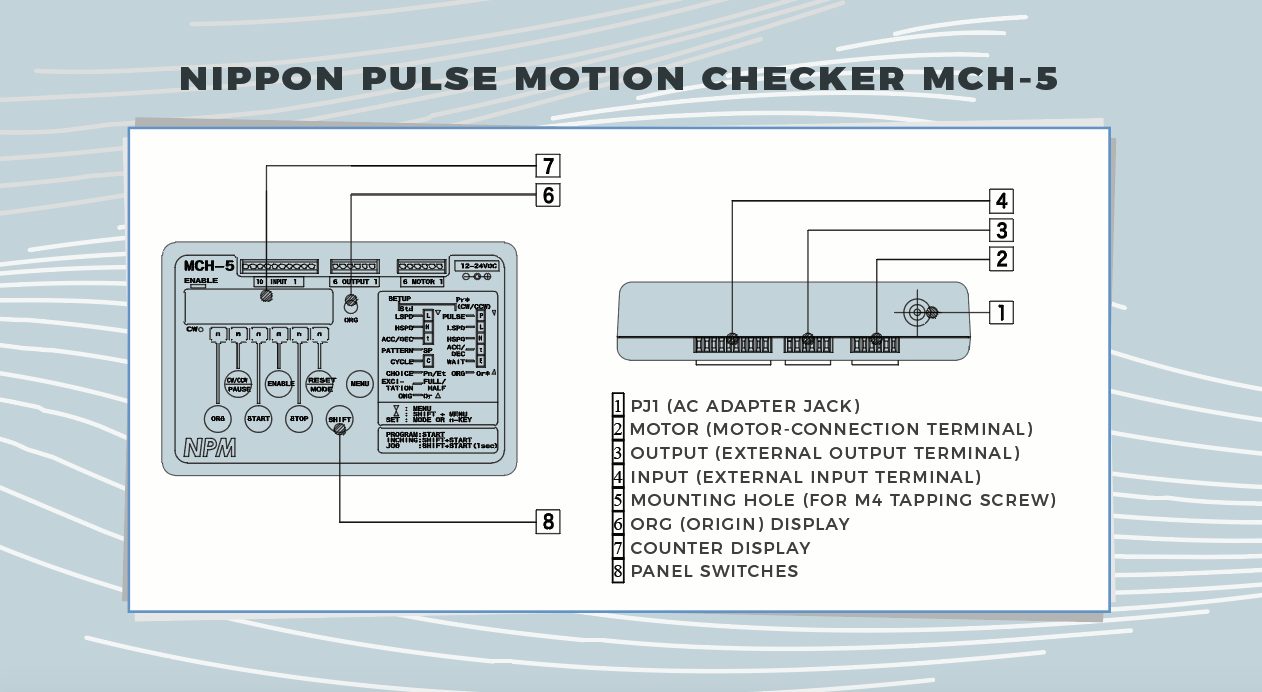
In a recent video, my colleague Miles Budimir and I got the chance to program and play with an MCH-5 motion checker controller from Nippon Pulse America. These come in versions for both unipolar and bipolar stepper motors, and we got a sample of one for bipolar. The controllers provide pulse-direction output signals — so the MCH-5 can also work as a standalone controller for any external stepper motor-driver board.


They’re available with input ports for external signals — including end limit and home-origin switches and external starts and stops. Plus they include nonvolatile memory that can save up to six different motion profiles. In fact, Nippon Pulse shipped the MCH-5 to us with this 25-gram PFCU-20 tin-can stepper motor. These motors are also called can-stack, claw-tooth, or claw-pole motors … which we cover in more depth here and here.
Click to enlarge.

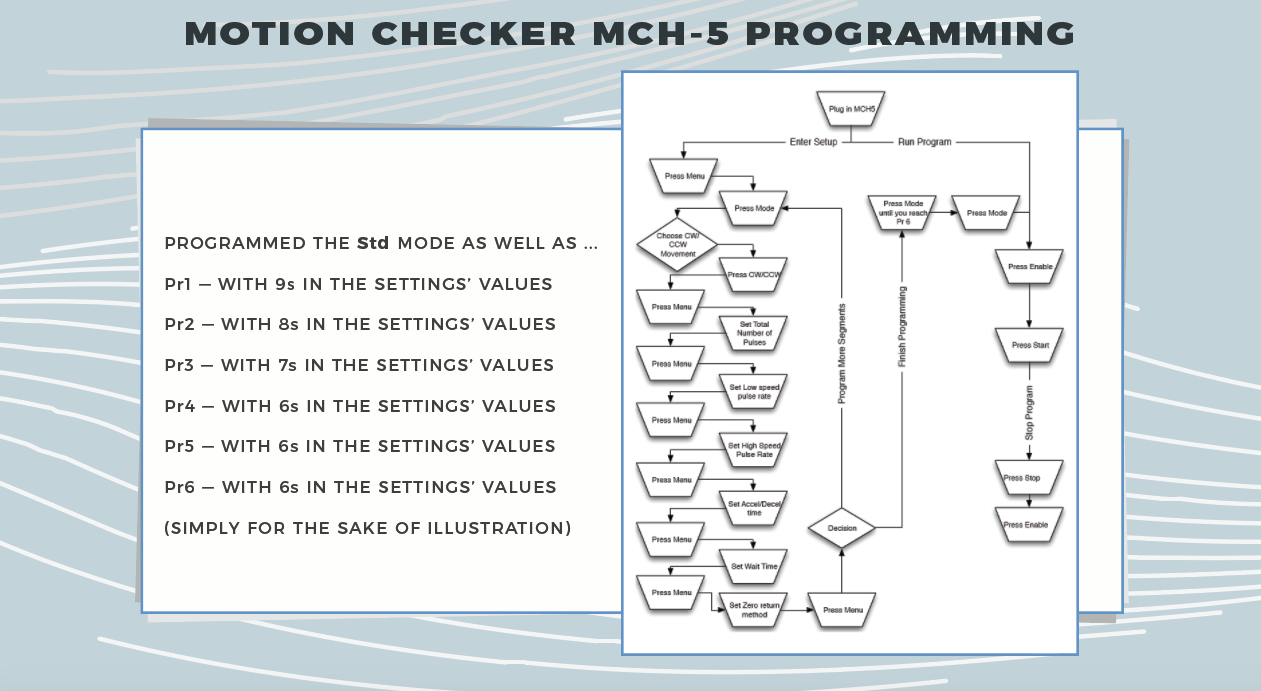
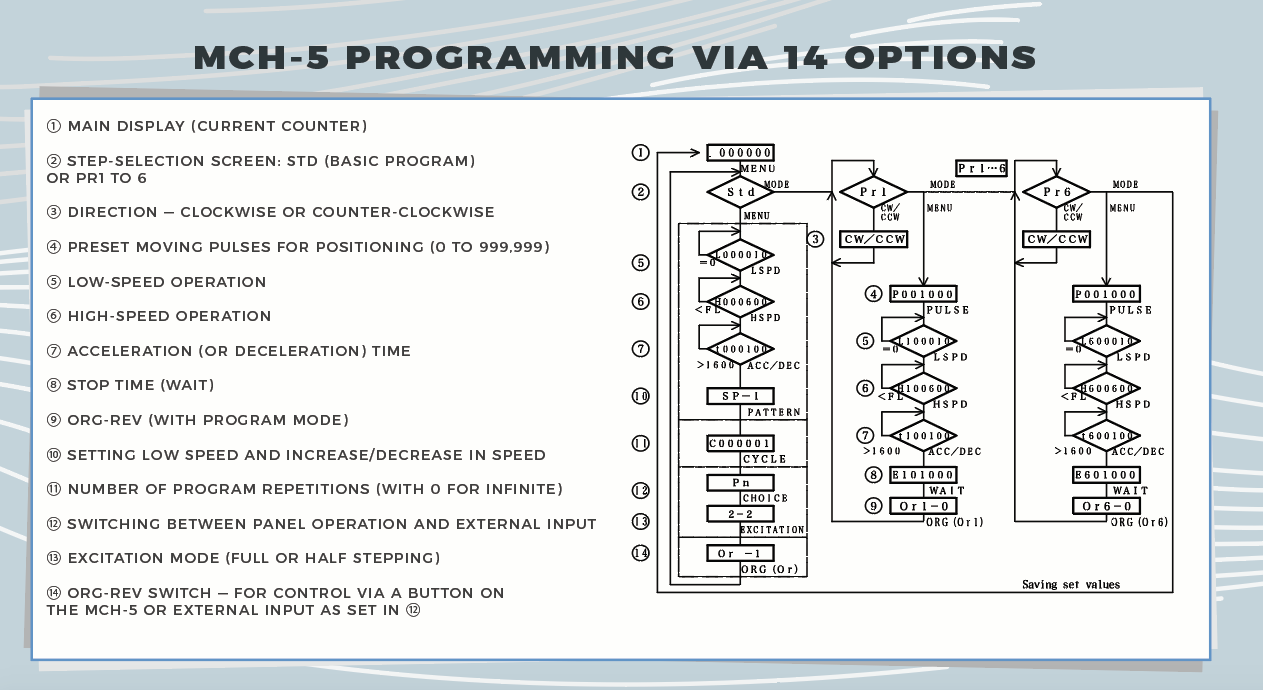
We connected the four wires for little stepper motor to the MCH-5 through the gang of terminals labeled motor. Then we programmed the controller’s standard mode as well as six routines by following a simple flowchart from Nippon Pulse. Users can use the MCH-5 to set the number of program repetitions, motor-shaft output direction, moving pulses for positioning, optional sensor input, low and high speeds, and acceleration and deceleration times between low and high speed. Other functions are a zero-return operation and jog and homing settings via the controller’s ORG switch.

Just for the sake of illustration and where it made sense, I arbitrarily filled all the user-selectable values for Pr1 with 9s for the leading digits; and Pr2 with 8s; and Pr3 with 7s; and Pr6, 5, and 4 with 6s for leading digits.

We also set the controller to drive the motor with full stepping (and not half stepping, which is another option). The controller has non-volatile memory and stores program settings even when unplugged.
Click to enlarge.

A key takeaway point on this little controller is that is has robust capabilities, especially for its compact size — and this little unit requires no connection to a CPU. The MCH-5 can also be programmed for burn-in testing to run stepper motors for extended periods (for detection of design problems before end products ship) … or the motor controller can be used to go back and forth indefinitely on product testing. For more information on tin-can stepper motors in general or the MCH-5 controller, visit the page detailing the MCH-5 at nipponpulse.com.

Click to enlarge.

You might also like

Filed Under: Controls, Editor Blogs, Featured, Stand-Alone Controllers

Reader Interactions

Leave a Reply

You must be logged in to post a comment.

Primary Sidebar

LEARNING CENTER

Design World Learning Center

Motion Control Handbook

“mct
EXPAND YOUR KNOWLEDGE AND STAY CONNECTED
Get the latest info on technologies, tools and strategies for Design Engineering Professionals.

RSS Featured White Papers

  • Robotic Automation is Indispensable for the Logistics Industry’s Continued Growth and Success
  • Reliable Linear Motion For Packaging Machines
  • Polymers Outperform Metals In Precision Gearing

Footer

Motion Control Tips

DESIGN WORLD NETWORK

Design World Online
The Robot Report
Coupling Tips
Linear Motion Tips
Bearing Tips
Fastener Engineering.
Wire and Cable Tips

MOTION CONTROL TIPS

Subscribe to our newsletter
Advertise with us
Contact us
About us

Copyright © 2025 · WTWH Media LLC and its licensors. All rights reserved.
The material on this site may not be reproduced, distributed, transmitted, cached or otherwise used, except with the prior written permission of WTWH Media.

Privacy Policy | RSS