
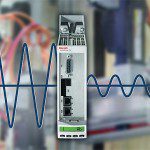
Allen-Bradley ControlLogix 5570 Series offer memory and speed

Rockwell Automation (www.rockwellautomation.com) has proudly released a range of programmable automation controllers (PACs) that offer manufacturers higher processing speed as it supports over 100 axes of motion. Seamlessly integrating through SERCOS and EtherNet/IP network interfaces, the Allen-Bradley Controllogix 5570 Series features optimized process, safety, motion and information capabilities.

The new series does not only increase the amount of information exchanged between the supervisory layers and the control, but it also boost system performance and improve productivity by enhancing access to real-time information.

Ideally suited for synchronizing complex motion applications, the ControlLogix 5570 Series offers high-speed axis and trajectory planning. With two to three times quicker scan times, the new controllers feature memory options ranging from 2 MB to 32 MB.

The new series includes the ControlLogix 5571, 5572S, 5572, 5573S, 5573, 5574 and 5575 controllers. In December, it will be expanded to include the GuardLogix 5573S and 5572S controllers, which are designed to provide similar automation capabilities as the ControlLogix platform and safety-rated control for safety-related functions.

Rockwell Automation Allen Bradley Controllogix 5570 Series

The controllers are fitted with on-board display features that offer improved diagnostics as well as run-time information to increase uptime and help ease troubleshooting. Its improved security features includes optimized data integrity and quicker data transference with its 1-GB secure digital card.

It will again be expanded in January with the addition of the ControlLogix 5573XT PAC. Suitable for extreme environments and rated for extended temperatures ranging from -25°C to 70°C, this soon-to-be addition is coated for use in corrosive and high-humidity environments.

Machine Controller

In the most general sense, a controller receives some type of input and produces outputs for some device, most commonly an electric motor. More specifically, machine control, unlike a more specific type of controller such as a motion controller, refers to the control of an entire stand-alone machine such as a CNC machine, packaging machine, or even a vending machine.

The machine controller’s primary operations include scanning I/O, updating output and process control. After an initialization phase, the controller will continuously read inputs, calculate control parameters for the machine process using application-specific logic based on the input data, and then update outputs to the machine. If the controller is turned off, some shutdown process may be completed.

The central part of a machine controller is the controller itself, which can take on several forms. For single machine control, a programmable logic controller (PLC) or a programmable automation controller (PAC) is usually sufficient to handle the job. PLCs are usually programmed using ladder logic or sequential function charts. The controller receives various sensor data, processes this information and executes controls via some combination of digital and/or analog I/O signals to turn on or off processes, actuate or stop movement, and take user or environmental input and make decisions based on these inputs. Machine controllers will generally work together with some type of human-machine interface (HMI). These can be either integrated with the controller as one piece or can be stand-alone units that communicate with the controller.

More recently, machine control has seen a move to PACs because they can offer better performance and a wider range of functions than traditional PLCs. For instance, PACs can support high-speed data acquisition and processing, as well as motion control and vision functions.

In order to take advantage of all the features and capabilities of a PAC, the application code must be well designed, balancing and coordinating various controller processes such as I/O, process control logic, communication to an HMI unit and other tasks.

There are a number of considerations to keep in mind when selecting a machine controller. One of the most important is the number and type (i.e. analog or digital) of I/O the controller will have to handle. Also, do the speed requirements of the machine match up with the controller’s capabilities? For instance, some machine controllers may be tasked with closing servo loops and thus must be capable of handling such a task.

Another consideration is the type of communication link needed. The machine may have special demands or may be wired to accommodate a specific networking protocol, so ensure that the controller can communicate with the machine. Related to the communication link is the programming environment. Is the controller simple to program? Can programs be edited quickly and easily? Lastly, consider any environmental factors in which the machine will have to operate such as shock and vibration, extreme temperatures, and moisture or humidity.

Vishay Precision launches new Weighing Systems with EtherNet/IP Protocol

Vishay Precision Group, Inc. (www.vishaypg.com) has announced that its VPG Process Weighing division has upgraded the fieldbus protocols of BLH-Nobel Weighing Systems G4 family of multi-channel weight or force indicators to include the EtherNet/IP open communications protocol.

Weighing Systems with EtherNetIP Protocol

This allows the instruments to communicate with other kinds of industrial control systems and their components like I/O systems or programmable automation and logic controllers.

G4 instruments from VPG provide high performance and high speed for industrial applications, including force measurement, process weighing and control, Web tension control and measurement, high dynamic force measurement, force vector calculations, automation and high-speed batching/blending systems. These units are certified to connect to a variety of communication interfaces, such as Profibus, Modbus/RTU, DeviceNet, RS232, RS485, USB, Modbus/TCP and EtherNet/IP.

The G4 family is available with four base mounting options: panel (PM), desktop (DT), harsh environment (HE) and DIN rail (RM). The IP65-rated G4-PM, HE and DT are integrated with 5.7” color graphic display and touchscreen for simple parameter changes and easy operation. The screen simultaneously displays up to four weight/force channels to allow user full control of multiple process vessels. Rated IP20, the G4-RM is designed for blind applications and needs a PLC/DCS interface.

The units can be configured for 24 VDC or 115/230 VAC operation. Software upgrades are downloadable from the company’s website and transferable to the instruments through a standard USB port connection. Custom software designed according to customer requirements for special applications can be made available when requested and is easily accommodated by the Microsoft Windows CE software platform. Remote access through a standard Web browser permits for monitoring, simple set-up and diagnostic tests.

CimQuest INGEAR releases .NET class libraries for Allen-Bradley Logix Controller

CimQuest INGEAR (www.ingeardrivers.com), which publishes runtime-free software development solutions for several industrial applications, is proud to announce the release of Visual Studio.NET class libraries to be used with Allen-Bradley ControlLogix and CompactLogix programmable automation controllers (PACs) (www.ab.com).

NET Class Libraries for Allen Bradley Logix Controller Family

INGEAR NET.LOGIX version 3.0 software can be used by those who write automation and control applications in Visual Studio C# or Visual Basic.NET to communicate with Allen-Bradley controllers, design data acquisition applications and custom communications, and deploy them on several machines, without the need to pay additional license fees.

“The better the information plant personnel have regarding operations, the greater their ability to manage costs, output, quality and ultimately — profitability. Some of the most valuable data lies within the programmable logic controllers (PLCs) that automate assembly lines. Manufacturers typically deploy PLCs machine-by-machine, so accessing that data can be a real challenge. This new set of class libraries provides anyone who knows Visual Basic.NET or Visual Studio C# everything they need to communicate with some of the world’s most popular Allen-Bradley controllers,” said Chuck Karwoski, head of CimQuest INGEAR.

NET.LOGIX 3.0 has several advanced features, including a new PeerMessage class for Unsolicited Messages, which waits idle in a passive state to allow the Allen-Bradley controller to send data through MSG instructions. Upon receiving communication, the PeerMessage class sends a notification event with information for the user application to process it immediately. The PeerMessage class is designed to receive MSG instructions from CompactLogix, ControlLogix, ControlLogix Gateway, MicroLogix, as well as PLC-5E and SLC 5/05 family of controllers.

NET.LOGIX 3.0 also features the DTEncoding class, which helps read and write Pre-Defined Types (PDT’s) and User Defined Types (UDT’s) as objects with or without the need to read or write every atomic member individually.

Ethernet Control Module with logic control engine and custom connectivity for industrial Ethernet Host Interface from MKS

MKS Instruments, Inc. (www.mksinst.com) is proud to announce the new Ethernet Control Module (“ECM”) programmable automation controller that is ideal for high-density industrial and commercial applications, as well as for remote monitoring applications including high I/O point counts. The new ECM can be enforced as a complete control platform for a complete manufacturing line or a single location. With its ability to do detailed execution tasks through cLogicTM engine and to operate certified programmable safety interlocks, the ECM can be utilized to neatly manage I/O through its custom distribution board.

ECM programmable automation controller

According to case studies, the compact footprint Ethernet Control Module can usually save operators 15 to 40 percent on their control and automation costs against other solutions. Additional to lowering cost, the flexibility of the expandable design allows operators to add I/O following installation by using the additional expansion slots.

The new ECM has a compact, high-density design, which reduces the number of controllers required to save cost and tool real estate. It is designed with interlock, digital and analog I/O connectivity in one controller. The ECM features reuse and adjust interlocking schemes on the fly to save costs and engineering time.

It features a cLogicTM that distributed real time logic engine allowing operators to control faster and more tightly than the original control scheme. It also features a data monitoring and control interfaces using Web browser, EtherCAT, DeviceNet, or Modbus/TCP for flexibility and migration. It has an expanded front panel LCD display that shows basic diagnostics and IP address, as well as status. With TOOLwebTM Interface, the new ECM can collect and analyze data. Through the standard Web browser, configuration and remote setup can be easily made.

New SNAP PAC Redundancy Option Kit to build redundant PAC systems from Opto 22

Opto 22 (www.opto22.com) unveiled the new SNAP PAC Redundancy Option Kit (“SNAP-PAC-ROK”) utilized to design Ethernet-based redundant control systems with maximum distributed intelligence and reliability that can immediately recover from failure.

SNAP PAC Redundancy Option Kit mc tips

Using Opto 22’s award-winning SNAP PAC System(tm) family, SNAP Ethernet I/O, and the latest PAC Project Professional 9.0 software suite, with the SNAP PAC Redundancy Option Kit, users can configure automation systems with dual PACs that essentially run and synchronize in parallel. When a controller fails or knocked offline, the other controller will take command and continue to perform the control program and applications it runs with no restart necessary or interruption. This feature, commonly called as “redundancy” in the automation industry, provides many advantages. Among these is an important reduction in mean time between failures (“MTBF”) of the control system, and thus greater levels of reliability for process-oriented applications in the manufacturing of thin film LCD, semiconductors and high-value product batches. Also, redundant control systems prove advantageous (“and are frequently mandated”) for handling, processing, and transport of byproducts, and oil and gas products, pharmaceuticals and chemicals.

For both established and new installations, redundant control systems from Opto 22 created with the SNAP PAC Redundancy Option Kit give several unique features. It offers unique flexibility and other benefits in system commissioning and start-up. Users can keep their control system operating and online even they make changes to or replace their control program. A controller becomes active and the other controller is updated once the new program is downloaded using the new instruction set.

Other features that the SNAP PAC Redundancy Option Kit (“and the redundant systems it establishes”) differ from other automation suppliers: It uses the Opto 22′s standard controllers with no required special redundant controllers. It communicates over Ethernet by standard Cat 5 cabling with no proprietary communication interfaces, protocols, or custom cables.

The new SNAP PAC Redundancy Option Kit has a SNAP PAC Redundancy Arbiter, a standalone processor which connects serially to both monitors and controllers. The SNAP PAC Redundancy Arbiter maintains organization of the control program during startup.

It also has a SNAP Redundant Power Switch that allows power re-starts to controllers during firmware upgrades.

The new Mid-range PACs integrated motion and safety by Rockwell Automation

Rockwell Automation (www.rockwellautomation.com) is proud to announce their latest two mid-range controllers which integrate drive control, discrete, motion and safety capabilities in a single device. The L45S Compact GuardLogix and Allen-Bradley L43S programmable automation controllers (“PACs”) offer functions that are previously available only on Rockwell`s larger Allen-Bradley ControlLogix. These include information and diagnostics capabilities, which help reduce prolonged restarts and nuisance shutdowns, as well as one programming environment.

Rockwell GuardCompactLogix Web

The new controllers use the same visualization, networking and configuration environment as Rockwell’s larger systems. It helps end-users and machine builders to integrate safety or machine applications cost-effectively to plantwide control systems.

Ken Deken, vice president for portfolio management of Rockwell, predicts that the two controllers will “open a new door for many manufacturers with mid-range applications who previously did not have the means to implement an integrated architecture. The scalability of the Integrated Architecture system means that manufacturers and machine builders can design their applications using a single control engine and a single development environment, regardless of the application size.”

By using Sercos communications, PACs can control approximately eight axes. When utilized with Allen-Bradley Kinetix 6200 servo drives, the controllers give machine builders advanced safety options such as safe direction and safe speed.

Also, the controllers support the use of Point Guard I/O modules and CompactBlock Guard I/O modules from Allen-Bradley on EtherNet/IP, enabling improved sharing and fast system configuration of information. The controllers have highest level of machine safety rating, up to SIL 3 and PL e.

When utilized with new RSLogix 5000 programming software from Rockwell, the latest PACs can utilize high-integrity add-on instructions (“AOIs”) for faster commissioning. The AOIs encapsulate code for usual routines to pre-validated modules, which can be easily reused to help lower risk of coding errors and save time. Manufacturers in regulated sectors, including food and beverage manufacturing and pharmaceuticals, can utilize the software to help protect intellectual property, fulfill regulatory requirements, and manage revision control.

The new PACwiz series with IEC 61131-3 syntaxes full compatibility from ADLINK

ADLINK Technology, Inc. (www.adlinktech.com) unveiled its first programmable automation controller (“PAC”) solutions, using the IEC 61131-3 programming standard, for automation applications — the PACwiz series. It provides a platform offering the convenience and performance of PAC development to automation application developers, with IEC 61131-3 syntaxes full compatibility, including five programmable logic controller (“PLC”) programming language standards. Using Pacwiz, PLC users can easily upgrade to a programmable automation controller platform without additional training as application development can be achieved in IEC 61131-3 languages, same as with traditional PLCs.

PACwiz series

The PACwiz series features distributed I/O of up to 2016 points and distributed motion control of up to 256 axes, which are time-deterministic. It not only allows configuration of I/O topology and the entire motion profile based on application requirements, it also provides flexible wiring configurations which reduce and simplify wiring costs between modules by 20 percent by using standard Ethernet cables.
Read more