
In this four-part article series, we cover the fundamentals and new innovations related to EtherCAT. In this installment, we detail the stable versioning that keeps 2004-era EtherCAT devices compatible with EtherCAT G networks, the speed, latency, bandwidth, and throughput figures that distinguish EtherCAT from other industrial Ethernet protocols, and how it handles cyclic and acyclic communications. We also compare EtherCAT distributed clocks with the IEEE 1588 Precision Time Protocol and Time-Sensitive Networking or TSN and survey the EtherCAT components available to machine builders.
Fieldbuses
POSITAL expands SSI options for IXARC encoders

POSITAL now supports SSI communication interfaces across a broad range of IXARC absolute rotary encoders. This includes both kit (modular) encoders and industrial encoders. Both are also available in POSITAL’s new 20 mm miniature form factor. For larger encoders, SSI interfaces are offered in several mechanical configurations, including 36 mm compact models, 58 mm rugged […]
Realtime systems benefit from multi-protocol motor and drive lines

Modern motion systems demand ultra-fast deterministic communication with precise multi-axis synchronization. So, engineers are turning to realtime Ethernet-based industrial protocols. Neyram Hemati, PhD Ankit Barad | Applied Motion Products Realtime motion control depends on fast, deterministic communication and precise synchronization across multiple axes. Among Ethernet-based technologies: EtherCAT delivers the highest synchronization accuracy and speed. EtherNet/IP […]
EtherCAT meets CRA Level 2 and higher-security options coming

EtherCAT meets CRA Security Level 2 requirements without modification. Extensions are being prepared for applications with higher security needs. TÜV SÜD is working with the EtherCAT Technology Group on an assessment report. Cybersecurity and cyber resilience are becoming more important as new legislation in Europe and other regions requires risk assessments and evidence of appropriate […]
What are latency and jitter and why are they important to industrial networks?
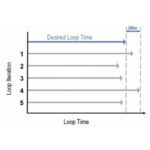
Applications that use closed-loop control often require communication networks that provide deterministic, real-time control of data transmission. This means the network guarantees that a message will be transmitted, or an event will be responded to, in a specified, predictable period of time — not faster or slower (deterministic) — and that the message will be transmitted […]
KEB America adds Modbus TCP/IP communication to S6 and F6 drives

KEB America, Inc. announces that the KEB F6 VFD and S6 Servo Drive now supports Modbus TCP/IP communication protocol. In addition to Modbus TCP/IP, the other supported Ethernet-based network communication protocols include EtherNet/IP, EtherCAT, ProfiNet, and Powerlink. “The variety of supported communication protocols in our drives give machine builders a lot of flexibility,” said Jonathan […]
What is cyclic synchronous control (position, velocity, and torque)?
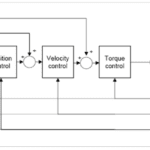
Cyclic synchronous control modes — cyclic synchronous position, cyclic synchronous velocity, and cyclic synchronous torque — are standardized operation modes of drives, defined in the CiA 402 profile specification, CANopen device profile for drives and motion control and included in the IEC 61800-7 standard, Adjustable speed electrical power drive systems — Part 7: Generic interface and use of […]
What is the CANopen over EtherCAT (CoE) protocol?
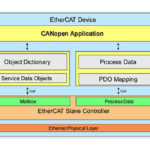
The CANopen over EtherCAT (CoE) protocol allows devices equipped with CANopen to be used on EtherCAT-based Industrial Ethernet networks. CANopen: Simple and low-cost CANopen is a communication protocol based on the CAN (Controller Area Network) physical communication standard. In the OSI communication model, CAN specifies the physical and data link layers, while CANopen addresses the […]
What is Single Pair Ethernet (SPE) and how is it used in industrial applications?

Single Pair Ethernet (SPE) is a technology that provides Ethernet transmission over a single pair of copper wires, while also transmitting power to connected devices via Power over Data Line (PoDL). Single Pair Ethernet was initially developed to meet the demands of the automotive industry — smaller, lighter cables and connectors for transmitting data from […]
What is AS-I Safety and what are its benefits for motion systems?
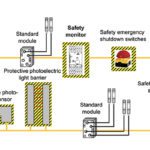
When sensors, actuators, and other lower-level components are used in a functional safety capacity, AS-Interface Safety at Work offers a simple, efficient, bus network for monitoring these safety devices — alongside standard, non-safety devices — on the AS-Interface cable. Recall that actuator-sensor interface (AS-Interface, or simply AS-I) is a master-slave bus that operates at the […]