• Skip to primary navigation
  • Skip to main content
  • Skip to primary sidebar
  • Skip to footer
  • Advertise
  • Subscribe

Motion Control Tips

Automation • Motion Control • Power Transmission

  • News
    • Industry News
    • Editor Blogs
  • Controls
    • HMIs
    • PC-Based Controllers
    • PLCs + PACs
    • Stand-Alone Controllers
    • Software
  • Drives
    • Servo Drives
    • Stepper Drives
  • Encoders
    • Absolute Encoders
    • Incremental Encoders
    • Rotary Encoders
  • Mechanical
    • Bearings
    • Brakes + Clutches
    • Belt + chain
    • Couplings
    • Gears + Gearing
    • Lubrication
    • Shock + Vibration Mitigation
    • Springs + Rings + Seals
  • Linear
    • Actuators
    • Linear Motors
    • Linear Encoders
  • Motors
    • AC Motors
    • DC Motors
    • Brushless Motors
    • Gearmotors
    • Piezo Motors
    • Servo Motors
    • Stepper Motors
  • Systems
    • Conveyors + linear transport systems
    • Gantries + Stages
    • Rotary Tables
    • Grippers + End Effectors
    • Robotics
  • Networks
    • Connections + Sliprings
    • Fieldbuses
    • I/O
    • Sensors + Vision
  • Resources
    • FAQs
      • Motion Casebook
      • Motion Selection Guides
    • Suppliers
    • Video
You are here: Home / Drives + Supplies / AutomationDirect’s White Paper on Top 10 Tips for Specifying VFDs

AutomationDirect’s White Paper on Top 10 Tips for Specifying VFDs

January 14, 2014 By Motion Control Tips Editor Leave a Comment

AutomationDirectVFDs can significantly extend the life of motors and cut operating costs, but selecting the right unit is critical to achieving these benefits.

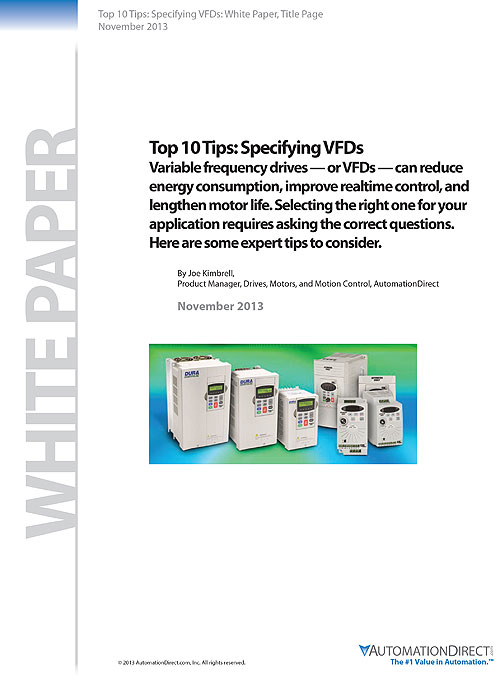
AutomationDirect announces the release of a new White Paper, “Top 10 Tips: Specifying VFDs” that explains the steps needed to choose the right variable-frequency drive (VFD) to maximize energy efficiency and reduce motor wear and tear.

A VFD lowers energy consumption by allowing the motor speed and power demand to match the load requirements. This also prolongs motor life as the motor doesn’t constantly stop and start to meet demand, but is ramped up to speed slowly, and only runs at full speed as required.

An AC motor alone will produce a starting current that can be upwards of eight times the full load amps of the motor. By pairing the motor with a VFD, the motor startup inrush current is minimized through a measured acceleration of the motor. This is especially important for applications that require many starts and stops, as excessive power requirements can trigger utility demand charges.

Simply adding a VFD, however, will not always produce the desired benefits if care isn’t taken in selecting the right one for the job. The impact of harmonics and heat can easily defeat the energy savings if the right steps aren’t taken to counteract these conditions.

This White Paper provides detailed information, such as determining load and braking requirements, to help users choose the right VFD. It also explains how to maximize benefits through various communication options and best operating practices, along with expert tips.

The White Paper is available as a Word document or can be downloaded as a PDF at: http://library.automationdirect.com/top-10-tips-specifying-vfds-white-paper/

AutomationDirect
www.automationdirect.com

You might also like

Filed Under: Drives + Supplies, Mechanical PT, Motors

Reader Interactions

Leave a Reply

You must be logged in to post a comment.

Primary Sidebar

LEARNING CENTER

Design World Learning Center

Motion Control Handbook

“mct
EXPAND YOUR KNOWLEDGE AND STAY CONNECTED
Get the latest info on technologies, tools and strategies for Design Engineering Professionals.

RSS Featured White Papers

  • Robotic Automation is Indispensable for the Logistics Industry’s Continued Growth and Success
  • Reliable Linear Motion For Packaging Machines
  • Polymers Outperform Metals In Precision Gearing

Footer

Motion Control Tips

DESIGN WORLD NETWORK

Design World Online
The Robot Report
Coupling Tips
Linear Motion Tips
Bearing Tips
Fastener Engineering.
Wire and Cable Tips

MOTION CONTROL TIPS

Subscribe to our newsletter
Advertise with us
Contact us
About us

Copyright © 2026 · WTWH Media LLC and its licensors. All rights reserved.
The material on this site may not be reproduced, distributed, transmitted, cached or otherwise used, except with the prior written permission of WTWH Media.

Privacy Policy | RSS