• Skip to primary navigation
  • Skip to main content
  • Skip to primary sidebar
  • Skip to footer
  • Advertise
  • Subscribe

Motion Control Tips

Automation • Motion Control • Power Transmission

  • News
    • Industry News
    • Editor Blogs
  • Controls
    • HMIs
    • PC-Based Controllers
    • PLCs + PACs
    • Stand-Alone Controllers
    • Software
  • Drives
    • Servo Drives
    • Stepper Drives
  • Encoders
    • Absolute Encoders
    • Incremental Encoders
    • Rotary Encoders
  • Mechanical
    • Bearings
    • Brakes + Clutches
    • Belt + chain
    • Couplings
    • Gears + Gearing
    • Lubrication
    • Shock + Vibration Mitigation
    • Springs + Rings + Seals
  • Linear
    • Actuators
    • Linear Motors
    • Linear Encoders
  • Motors
    • AC Motors
    • DC Motors
    • Brushless Motors
    • Gearmotors
    • Piezo Motors
    • Servo Motors
    • Stepper Motors
  • Systems
    • Conveyors + linear transport systems
    • Gantries + Stages
    • Rotary Tables
    • Grippers + End Effectors
    • Robotics
  • Networks
    • Connections + Sliprings
    • Fieldbuses
    • I/O
    • Sensors + Vision
  • Resources
    • FAQs
      • Motion Casebook
      • Motion Selection Guides
    • Suppliers
    • Video
You are here: Home / Encoders / What are pulses per revolution for encoders?

What are pulses per revolution for encoders?

April 11, 2018 By Miles Budimir Leave a Comment

Pulses per revolution (or PPR) is a parameter associated with encoders. Basically, it is a measure of the number of pulses per full revolution or turn of the encoder, with a full revolution being 360 degrees. In essence, it is a measure of an encoder’s resolution.

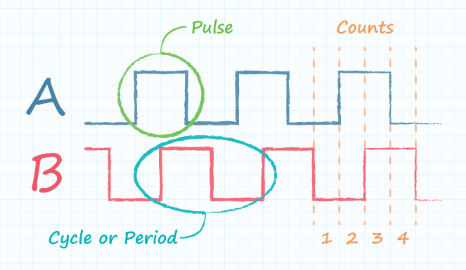
But what counts as a pulse may have different definitions depending on the manufacturer. For instance, some encoder manufacturers denote a pulse as only the high portion of the square wave pulse an encoder produces. Think of a single cycle of a square wave composed of a high (logic “1”) and low (logic “0”) portions of the signal. So the pulse is the high portion, and represents one whole cycle of high and low.
encoder
The drawing illustrates the several ways encoder resolution can be defined; as pulses, cycles, periods, or counts per revolution. (Image via CUI Inc.)

Complicating things further is the fact that some manufacturers use different terminology that may denote the same or a different definition. For example, one alternative measure is cycles per revolution (CPR). This refers to one complete cycle of high and low and is equivalent to the PPR measure. However, another measure, counts per revolution (CPR), refers to the actual number of states in a quadrature encoder, which for one complete square-wave cycle is 4, and is not equivalent to cycles per revolution nor PPR.

The bottom line is to do one’s due diligence; check to make sure what PPR or CPR refers to in specifications for an individual encoder.

 

You might also like

Filed Under: Encoders, FAQs + basics

Reader Interactions

Leave a Reply

You must be logged in to post a comment.

Primary Sidebar

LEARNING CENTER

Design World Learning Center

Motion Control Handbook

“mct
EXPAND YOUR KNOWLEDGE AND STAY CONNECTED
Get the latest info on technologies, tools and strategies for Design Engineering Professionals.

RSS Featured White Papers

  • Robotic Automation is Indispensable for the Logistics Industry’s Continued Growth and Success
  • Reliable Linear Motion For Packaging Machines
  • Polymers Outperform Metals In Precision Gearing

Footer

Motion Control Tips

DESIGN WORLD NETWORK

Design World Online
The Robot Report
Coupling Tips
Linear Motion Tips
Bearing Tips
Fastener Engineering.
Wire and Cable Tips

MOTION CONTROL TIPS

Subscribe to our newsletter
Advertise with us
Contact us
About us

Copyright © 2025 · WTWH Media LLC and its licensors. All rights reserved.
The material on this site may not be reproduced, distributed, transmitted, cached or otherwise used, except with the prior written permission of WTWH Media.

Privacy Policy | RSS