Torque-dense and efficient motors are essential in developing humanoid robots. And brushed dc motors are answering the call.
Edited by Miles Budimir
Senior Editor
Humanoid robots, designed to operate in close interaction with humans, rely heavily on smooth and controlled joint and limb motion. This makes the selection of the motors that power the axes of motion critical. Alongside high torque density and responsiveness, efficiency to enable long battery life is key, and reliability is also important. Achieving freedom of movement requires integrating numerous axes of motion, which is best accomplished by working closely with an expert in this field.
In education and therapy applications, humanoid robots are used to assist hands-on learning and development across a range of subjects and requirements. In the study of engineering, students can develop skills in programming, while in health and therapy settings, patients can receive rehabilitative care through humanoid robot interaction.
Humanoid robots can be equipped with a ‘brain’ tailored to their specific tasks, supported by targeted programming and artificial intelligence. Despite this customization, they share a common human-like form, including hands or grippers. While sensors and tools can be added for physical modularity, the motor skill requirements for humanoid robots remain broadly similar across various tasks.

For robot developers, the general universality in physical motion enables a single humanoid design to be used as a basis for multiple applications. However, to achieve this scale of movement and utility for widespread tasks, humanoid robots typically need to optimize 20 or more degrees of freedom. Accordingly, the operational performance of the actuators that power these axes of motion is crucial.
Portescap, which designs and manufactures miniature motors, recently specified a motion solution for an existing humanoid robot design. The robot manufacturer needed compatibility with their existing drives and controls but wanted to increase torque density and reduce mass. This would be central to improving the robot’s precision by optimizing control of movement, increasing responsiveness, and reducing inertia.
The robot developer also wanted to extend battery lifetime, so the motors needed to have high efficiency. With more than 20 motors per unit, and robots used across a diverse array of environments, reliability was also a priority. The relatively high number of motors per robot, combined with the purchasing demands of the end- user markets, meant that the need to balance cost with value was also important.
The engineering team determined that the characteristics of a brushed dc motor would best fulfil the requirements. Providing simplicity of control, this motor design would ensure integration with the humanoid’s existing architecture. While achieving the cost-point required by the OEM, the inherent characteristics of a brushed dc motor would be well-matched to a humanoid’s close human interaction, where the advantages of high torque at low speed would enable fine control.
Background on brushed dc motors
Why brushed dc motors? They offer a number of features that are useful in robotic applications. Here’s an overview of brushed dc motor design, and in particular the advantages of coreless dc motors.
A typical brushed dc motor consists of an outer stator, typically made of either a permanent magnet or electromagnetic windings, and an inner rotor made of iron laminations with coil windings. A segmented commutator and brushes control the sequence in which the rotor windings are energized, to produce continuous rotation.
Coreless dc motors do away with the laminated iron core in the rotor. Instead, the rotor windings are wound in a skewed, or honeycomb, fashion to form a self-supporting hollow cylinder or “basket.” Because there is no iron core to support the windings, they are often held together with epoxy. The stator is made of a rare-earth magnets, such as neodymium, AlNiCo (aluminum-nickel-cobalt), or SmCo (samarium-cobalt), and sits inside the coreless rotor.

The brushes used in coreless dc motors can be made of precious metal or graphite. Precious metal brushes (silver, gold, platinum, or palladium) are paired with precious metal commutators. This design has low contact resistance and is often used in low-current applications. When sintered metal graphite brushes are used, the commutator is made of copper. The copper-graphite combination is more suitable for applications requiring higher power and higher current.
The construction of coreless dc motors provides several advantages over traditional, iron core dc motors. First, the elimination of iron significantly reduces the mass and inertia of the rotor, so very rapid acceleration and deceleration rates are possible. And no iron also means no iron losses, giving coreless designs significantly higher efficiencies (up to 90 percent) than traditional dc motors. The coreless design also reduces winding inductance, so sparking between the brushes and commutator is reduced, increasing motor life and reducing electromagnetic interference (EMI).
Motor cogging, which is an issue in traditional dc motors due to the magnetic interaction of the permanent magnets and the iron laminations, is also eliminated, since there are no laminations in the ironless design. And in turn, torque ripple is extremely low, which provides smooth motor rotation with minimal vibration and noise.
Because these motors are often used for highly dynamic movements (high acceleration and deceleration), the coils in the rotor must be able to withstand high torque and dissipate significant heat generated by peak currents. Because there’s no iron core to act as a heat sink, the motor housing often contains ports to facilitate forced air cooling.
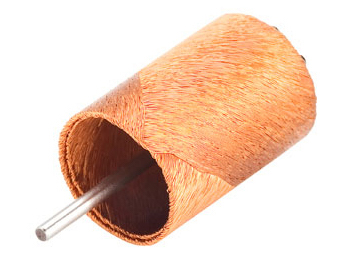
The compact design of coreless dc motors lends itself to applications that require a high power-to-size ratio, with motor sizes typically in the range of 6 to 75 mm, although sizes down to 1 mm are available, and power ratings of generally 250 W or less. Coreless designs are an especially good solution for battery-powered devices because they draw extremely low current at no-load conditions.
Coreless dc motors are used extensively in medical applications, including prosthetics, small pumps (such as insulin pumps), laboratory equipment, and X-ray machines. Their ability to handle fast, dynamic moves also make them ideal for use in robotic applications.
Coreless motors
Portescap specified a 16DCT Athlonix motor, based around a coreless design. This saves significant weight compared to incorporating a traditional iron core and enables greater responsivity and smoother motion thanks to reduced inertia. Neodymium magnets also increase torque density by achieving a stronger magnetic field, enhancing the interaction with the motor windings.
The coreless design was also specified to increase efficiency and reduce energy consumption by removing the effects of hysteresis and eddy current losses associated with a conventional iron core dc motor. Precious metal commutation also enhances efficiency by reducing resistance and minimizing the voltage drop across the brush-commutator interface.
The optimized ironless construction of the motors allowed cooler operation and improved power density. Motor inductances were adjusted to match drive requirements, ensuring optimal speed and torque characteristics.
To further minimize weight, the engineers customized the windings with lightweight, self-supporting coils. Combined with the coreless design and neodymium magnets, these advantages achieved up to an 8 % reduction in motor diameter while delivering the necessary torque.
To further increase durability, as well as improve torque transfer, the engineers also integrated the pinion gear into the motor shaft. This approach would optimize alignment and enhance control at each axis, minimizing play, which would also reduce mechanical wear.
Thanks to the collaboration between the robotic and motion engineering teams, the developer was able to achieve the targeted size and weight as well as the required motion profile for each axis.
Portescap
www.portescap.com

Leave a Reply
You must be logged in to post a comment.