When it comes to communications in motion systems, there are a range of options depending on the specific type of use case. For instance, connecting together a series of drives and motors with controllers can be done with a number of different network protocols such as Ethernet, EtherCAT, CAN, or others.
On a different scale, for instance, at the controller level (or the circuit board level of the controller or microcontroller), different communication protocols are more apt. For instance, such is the case with the serial peripheral interface, or SPI.
Serial peripheral interface (SPI) is a commonly used input-output standard for synchronous serial data transmission. It’s used mainly in embedded systems for short distance communication between various integrated circuits.
At the basic physical layer, it is a four-wire serial interface supporting full duplex communication. Data rates can vary from a few MHz to upwards of 10 MHz or better in some cases. Data transmission is from two to 24 bits, depending on how it is programmed.
SPI is used to transmit data between microcontrollers and a number of peripheral devices, including various sensor types, control devices, memory cards, and displays, among others.
Because SPI is a serial interface using only four wires, it saves significant PC board space compared with parallel bus systems. This makes it especially useful for embedded systems where board space is limited.
So, how is SPI used in drive and control circuits? Typically, a motor driver with SPI connectivity will have an SPI port that can be connected to a microcontroller which sends control signals such as PWM signals. Or in some cases the controller may reside on the same chip where the control signals are generated. Aside from control, SPI can also be used for diagnostic purposes.
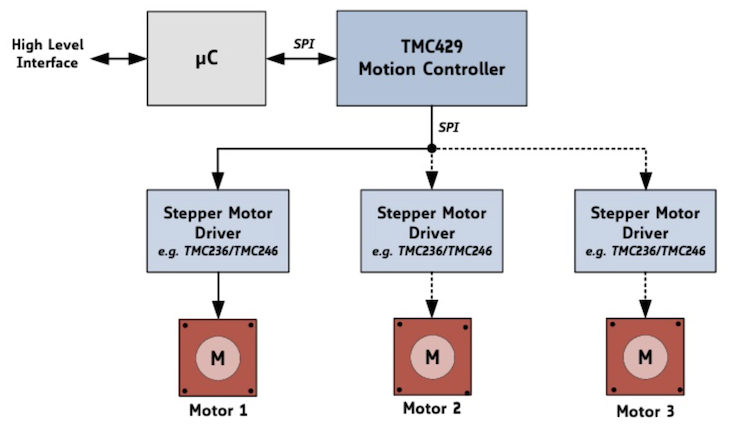
SPI is also used in the master/follower configuration, with a master controller and one or more follower devices.
As an example, consider a motion control system built around the Analog Devices TMC429 motion controller chip which features an SPI controller and driver interface. In this case, the TMC429 chip serves as a three-axis motion controller. The TMC429 controls the stepper motor position by sending pulses for step and direction signals to a stepper motor driver. The driver chip converts the step and direction signals to coil currents for the stepper motors. Here, two separate four-wire SPI interfaces allow for communication with the microcontroller and with up to three daisy chained stepper motor drivers.
Such motion control chips with SPI are being implemented in a wide variety of applications, including in automating laboratory equipment, in 3D-printing systems, as well as other automation applications. For example, as electrification increases in vehicle subsystems, chip manufacturers are introducing motor controllers for the growing number of motors in vehicles. Toshiba, for instance, has introduced new gate drivers for brushed dc motors in automotive applications. The TB9104FTG gate driver features integrated SPI with on-board motor control circuits, and also includes built-in motor current sense amplifiers circuitry as well as a built-in PWM drive circuit.

Leave a Reply
You must be logged in to post a comment.