Slip-ring variations abound — and the advanced components come in bore sizes from half an inch to many feet in diameter — for medical-imaging machines designed to service livestock, for example. But options go beyond mere scale. So how do OEMs and design engineers choose between standard and custom options … and what are other options beyond the most widespread variations of electromechanical and fiber-optic slip rings? Let’s explore.
Standard slip-ring options for OEMs
Some slip rings are sold as standard product offerings. These slip rings are easy to add to machine builds — with harnesses for simple connectivity as well as standard mounting interfaces. The latter can be in the form of a flange, threaded rotor, mounting on a shaft, or fitted into a shaft’s internal bore.
Standard hardware can serve a secondary purpose — ensuring slip-ring installation alignment to within tolerances for proper operation. Required shaft alignment is sometimes expressed to within some value of runout; slip-ring face perpendicularity to the axis is usually held to even tighter tolerances.

Circuitry options include various standard contacts to satisfy amperage and voltage ranges — ac or dc.
For example, the manufacturer Deublin (known for supplying customs to the industry) is now getting into offering more off-the-shelf slip rings in standard product lines. This is an interesting departure from the general trend towards customization in industrial components.
Where might standard slip rings work? Well, an engineer might know he or she needs ten channels or ten individual circuits over a slip ring … and an off-the-shelf item will get this job done. Of course, there are other design considerations — and an engineer that chooses a standard slip ring may ultimately end up with a slip ring that’s a bit larger than needed … but in the end, the benefits of an off-the-shelf selection maybe worth the overbuild.
In other cases, engineers don’t always know upfront the number of dedicated circuits required — or Ethernet connections, for example.
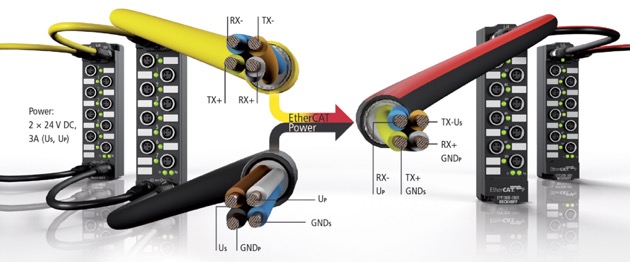
Note: One factor related to Ethernet that often confounds engineers is that one basic cable has four 100-megabit Ethernet runs — containing only four individual wires. But the outside of that cable is metal braid for shielding. 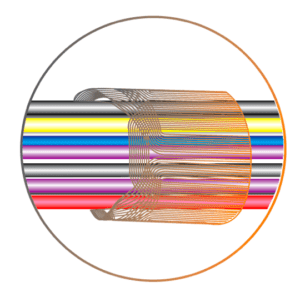 That metal braid counts as an additional circuit. So slip-ring manufacturer count five circuits or traces minimum for a standard Ethernet line … though many design engineers will think it’s only four.
Ultimately, issues like these underscore the importance of market education and communication between manufacturers and the design engineer on how to fit designs with slip rings.
It also illustrates the need for both off-the-shelf and custom slip-ring options … to serve design engineers with tight design cycles and those who need more involvement to develop very specific builds.
Custom slip rings
In many cases, trying to fit a standard slip ring to a design ranges from challenging to impossible. That’s in part because there are just so many things to consider in regard to slip-ring design … far more to consider than most engineers initially assume. Custom-designed slip rings are specific to design engineers’ specifications — pun intended.
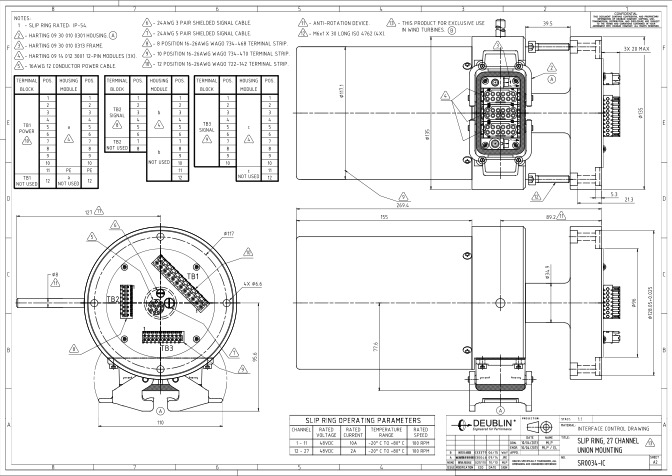
Some customized designs that incorporate slip rings take different formats … for example, some slip rings ultimately come in unexpected housings … assemblies with square footprints, for example. Deublin supplied one such slip ring with an inner diameter of about 13 in. and the sides of the outer box were about 24 in. each … not a morphology most engineers associate with slip-ring designs. These are truly custom subsystems designed for a tight fit into the machine.
In fact, custom slip rings can include combinations of connection and trace types; encoders and other feedback devices; heaters, if needed; shielding for EMC and subcomponents rated for high temperatures, if those are concerns; and mixed-signal handling. Some manufacturers can deliver custom slip rings in a few weeks.
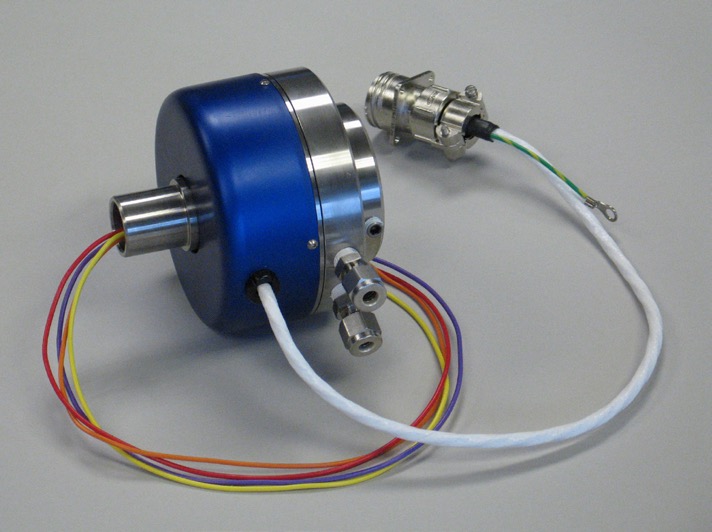
Note: Slip rings fully integrated into rotary unions can take customization a step further … to simplify installation and minimize maintenance. That’s in part because the connectors for electric and fluid-power hoses and cables can be designed to join and unplug together —with quick-connect hardware.
Don’t discount how complicated these subcomponents can be. Visit Design World’s connectortips.com site for more on what advanced connectors look like.
Now let’s explore three less common slip-ring design iterations that provide still more options to design engineers looking to connect rotating and stationary machine-build segments.
Wireless alternative #1 — inductive slip rings
Not as widespread as electromechanical and fiber-optic slip rings but certainly commercialized, some slip rings use inductive coupling for the mode of transmission. Benefits include long-life friction-free operation with no arcing — helpful where settings include flammable materials.
How do they work? Well, inductive assemblies act as transformers but with relative movement between coils — called the primary and secondary in this context. Cores (usually of layered silicon steel) couple the coils. (By the way, the core material choice is to minimize the generation of heat from eddy currents.) The transmission of electrical power is constant, regardless of rpm or the position of the stationary and rotating coils. Some versions boost power transfer efficiency with self-harmonizing functions — useful in the face of fluctuating loads or settings.
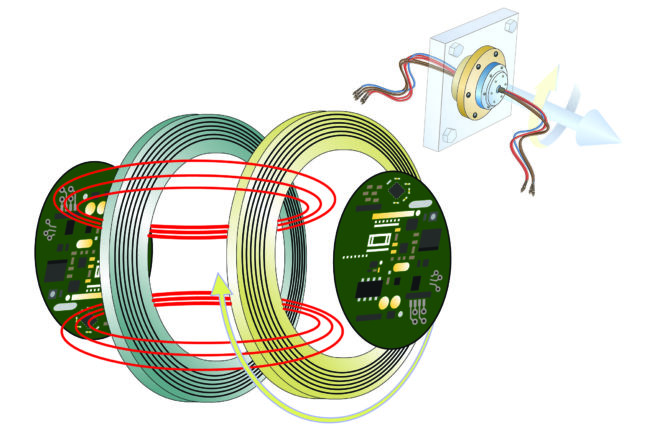
One caveat: Most inductive designs are more suitable for the transmission of power or low-frequency signals (in the case of data transmission) than they are for high-frequency signal conveyance.
Where do slip rings based on inductive coupling work? They are found in the wind-power industry. Read more about this on Design World’s sister site windpowerengineering.com, which discusses iterations specific to turbines. Inductive coupling slip rings are also useful on packaging applications where axes run at high rpm.
Wireless alternative #2 — Slip rings that use capacitance
Note that there are also wireless slip rings that work by leveraging detection of capacitance. In contrast with inductive variations using magnetic fields from conductive segments, capacitive variations employ electric fields.

Mercury-wetted slip rings
 Yet another type of slip ring is a mercury-wetted slip ring. Here, pools of liquid metal make the rotating connections. Mercury is a toxic heavy metal so not suitable everywhere — certainly not where food and beverage products are processed. But the material gives slip rings long life for both data and power transmission — along with low-noise operation.
Resistance through the contacts is less than one mΩ. Compare that to traditional brush-and-ring setups of 10 to 20 times that. Life is also longer with mercury-wetted slip rings — to a billion revolutions compared to tens of millions from brush-and-ring setups.

Leave a Reply
You must be logged in to post a comment.