• Skip to primary navigation
  • Skip to main content
  • Skip to primary sidebar
  • Skip to footer
  • Advertise
  • Subscribe

Motion Control Tips

Automation • Motion Control • Power Transmission

  • News
    • Industry News
    • Editor Blogs
  • Controls
    • HMIs
    • PC-Based Controllers
    • PLCs + PACs
    • Stand-Alone Controllers
    • Software
  • Drives
    • Servo Drives
    • Stepper Drives
  • Encoders
    • Absolute Encoders
    • Incremental Encoders
    • Rotary Encoders
  • Mechanical
    • Bearings
    • Brakes + Clutches
    • Belt + chain
    • Couplings
    • Gears + Gearing
    • Lubrication
    • Shock + Vibration Mitigation
    • Springs + Rings + Seals
  • Linear
    • Actuators
    • Linear Motors
    • Linear Encoders
  • Motors
    • AC Motors
    • DC Motors
    • Brushless Motors
    • Gearmotors
    • Piezo Motors
    • Servo Motors
    • Stepper Motors
  • Systems
    • Conveyors + linear transport systems
    • Gantries + Stages
    • Rotary Tables
    • Grippers + End Effectors
    • Robotics
  • Networks
    • Connections + Sliprings
    • Fieldbuses
    • I/O
    • Sensors + Vision
  • Resources
    • FAQs
      • Motion Casebook
      • Motion Selection Guides
    • Suppliers
    • Video
You are here: Home / Controls / PLCs + PACs / What do USB data-logging ports do on programmable automation controllers (PACs)?

What do USB data-logging ports do on programmable automation controllers (PACs)?

May 10, 2017 By Lisa Eitel Leave a Comment

By Steve Meyer || Data logging (and use of that data later) was once a complicated venture possible only through specialty hardware and applications — often in the form of standalone supervisory control and data acquisition or SCADA systems. Even new software and PC-based systems come at significant cost. In contrast, many of today’s programmable automation controllers (PACs) and even many PLCs include built-in data logging, storage, and networking functions. These let users collect and access this output through connections such as an Ethernet network or (as we’ll explore here) the ubiquitous USB mass-storage devices we call flash drives, pen drives, or thumb drives.

As the name implies, a USB data-logging port provides a means of storing data from a system using removable memory in the form of flash drives. USB ports provide inexpensive and (in most cases) secure means of moving data without broadcasting information over a network.
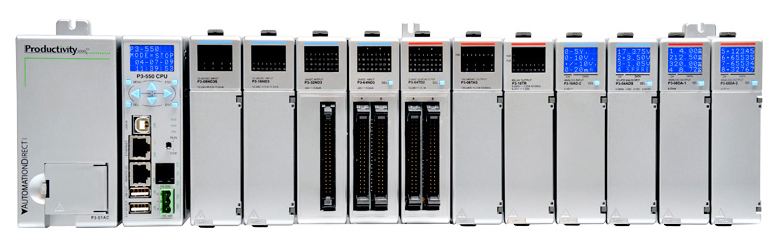
This AutomationDirect Productivity 3000 programmable automation controller (PAC) is modular to let engineers set up reliable operations and communications. The controller provides the robust communication, user-friendly programming, integrated data storage, and processing power needed for today’s industrial automation projects. Notice how the controller CPU communications ports include those for USB data logging.

Such memory is self-contained and removable, so doesn’t involve any hardware resources within the controller beyond the port control function itself. In addition, flash drives can store controller programming to serve as a backup for existing programs — or as an upgrade if there are project changes needing implementation. Typical data-logging flash drives include a processor with memory to function as an intelligent peripheral — so can upload data and programs to the controller without a laptop.

For applications needing small size and convenience, there are now USB drives with enough onboard intelligence to operate full data-gathering devices for analog data storage of all kinds. Some USB drives are preconfigured to read signals from thermocouples and other temperature, pressure, humidity, current, and chemical sensors outputting 4-to-20-mA current-loop values. These drives are easy to configure for the number of readings to be taken and the time scale to be used. Such setups eliminate data-acquisition hardware where only a single of few channels of data are required. The memory format’s small size maximizes portability and ease of use in remote locations.

More complex applications generating multi-channel data (acquired through a PAC or other data-acquisition system) can store it on a USB drive. There’s typically less data within any given timeframe, as there are multiple channels. The convenience is that the data can then be sent or transported to a PAC for analysis as needed without concern for data-integrity loss.

 

You might also like

Filed Under: FAQs + basics, Featured, PLCs + PACs

Reader Interactions

Leave a Reply

You must be logged in to post a comment.

Primary Sidebar

LEARNING CENTER

Design World Learning Center

Motion Control Handbook

“mct
EXPAND YOUR KNOWLEDGE AND STAY CONNECTED
Get the latest info on technologies, tools and strategies for Design Engineering Professionals.

RSS Featured White Papers

  • Robotic Automation is Indispensable for the Logistics Industry’s Continued Growth and Success
  • Reliable Linear Motion For Packaging Machines
  • Polymers Outperform Metals In Precision Gearing

Footer

Motion Control Tips

DESIGN WORLD NETWORK

Design World Online
The Robot Report
Coupling Tips
Linear Motion Tips
Bearing Tips
Fastener Engineering.
Wire and Cable Tips

MOTION CONTROL TIPS

Subscribe to our newsletter
Advertise with us
Contact us
About us

Copyright © 2026 · WTWH Media LLC and its licensors. All rights reserved.
The material on this site may not be reproduced, distributed, transmitted, cached or otherwise used, except with the prior written permission of WTWH Media.

Privacy Policy | RSS