Today’s motor drives and controls feature a bevy of safety functions. These include protecting the motor from overloads of power or current, short circuits and ground faults, and monitoring for over current conditions and over and under voltage conditions as well, and even over temperature protection to protect from excessive heat that a servo motor may experience.
In addition to emergency stop features, a common feature is Safe Torque Off (STO).
Most commonly, STO is helpful in applications where the motor needs to come to a quick and safe stop but without applying a mechanical brake, such as in many servo motor applications.
So, how does STO work? STO is a drive-based function. It stops the drive from providing power to the motor without interrupting power to the drive itself. When the STO function is activated, the motor loses power and coasts to a stop, with the stopping time based on the system inertia and friction. The STO function prevents a motor from an unexpected start as well, which is useful for motor maintenance or troubleshooting.
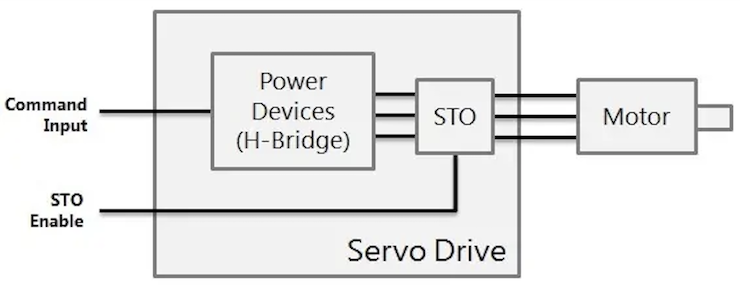
In both cases (shutting off the motor and preventing an unexpected start), power to the motor is cut off and remains off. Electrically, the power (or current) source to the motor is cut off via circuitry within the drive, which does not affect any of the other drive functions. In effect, power is cut off to the gate circuitry that provides current to the motor and produces torque. So, the drive can remain connected to a power supply without the motor receiving any power.
The STO function is suitable for servo motor applications. For starters, STO works well for systems or servo motors with low inertia and high friction, meaning that the motor will stop in a relatively short amount of time once the STO function is initiated. Of course, this works in systems where the time for the motor to come to a complete stop is not critical to safety.
With the motor stopped, the motor or other moving parts can be accessed for check-ups or maintenance without the motor restarting. Examples might include performing routine maintenance, checking for or repairing any damage in the system, or clearing any blockages in the system.
The STO function is designed to reduce workplace injuries by stopping motor rotation and preventing any unexpected startup of the motor. However, this much needs to be clear. Because STO doesn’t cut power to the drive itself, it remains energized, so any work to the drive itself means that power to the drive must be cut off. In other words, STO doesn’t isolate the drive from the electrical input, it only cuts power to the motor.
In the end, STO is just one of many safety functions at work in today’s motor drive systems. Some of these include other “safe” functions such as safe speed, safe acceleration, and safe position control. In addition to these, there are hard-wired emergency or E Stops that have a long tradition of being used to stop a motor in an emergency situation. And of course, there are also mechanical braking systems that can be implemented to either add redundancy or as an alternative stopping method.

Leave a Reply
You must be logged in to post a comment.