
By Miles Budimir •
Gearmotors are most common in applications that need a lot of force to move heavy objects. Most industrial gearmotors incorporate fixed-speed ac motors. However, some gearmotors use dc motors, which are common in automotive applications in adjustable side-view mirrors and automatic seat adjustments.
Though it’s possible to combine many different motors and gearsets, not just any one will work for every application because certain combinations are more efficient and cost-effective than others. This is why knowing the application and getting an accurate estimation of its required torque and operating speeds is the foundation for successfully integrating a gearmotor into a system.
Typically, gearmotors outperform other motor-gear combinations. More importantly, gearmotors simplify design implementation because they save engineers from integrating motors with gears, which in turn reduces engineering costs. If the application requirements are known, engineers can order the right gearmotor from a supplier directly.
What’s more, if a gearmotor is sized properly, having the right combination of motor and gearing can prolong design life and boost overall design efficiency. Gearmotors can also eliminate the need for couplings and potential alignment problems that come with those components. Such problems are common when a design includes the connection of a separate motor and gear reducer—which in turn increases the potential for misalignment and bearing failure.
As applications for gearmotors expand, manufacturers are seeing a change in expectations from end users. For instance, end users have an increased expectation for more integrated designs. Meanwhile, other companies are reporting that the design requests they’re receiving are becoming more complex, requiring more customization and creative thinking.
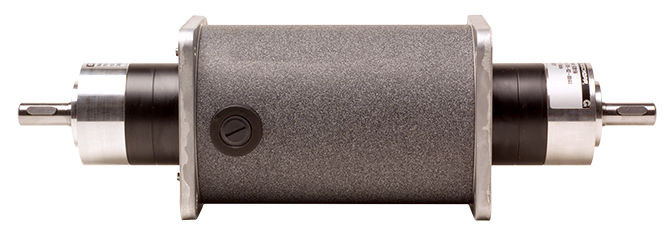
Dual output gearmotor delivers quiet, synchronized motion
One such challenging application comes from the medical industry. Specifically, tables for surgical procedures that have extremely accurate positioning demands.
Highly specialized surgical procedures, such as those focusing on spinal, joint replacement and orthopedic trauma, require automated operating room tables that can be positioned with extreme accuracy. This is best achieved using a compact gearmotor with a high torque output—intermittent duty loads up to 500 lb—and quiet operation. Recently, Groschopp partnered with one of the world’s leading designers and manufacturers of medical products to build the best solution for their surgical tables.
This particular table had two hinged arms that needed to be driven simultaneously so the alignment and movement would be synchronized. Rather than following the traditional method of link chains, belts and pulleys, which have greater margins of operation error, Groschopp thought that a single motor with two outputs would provide greater accuracy and be more cost effective. Due to the intermittent operation, Groschopp’s design engineers were able to meet the 24-V power supply specification. The high efficiency of the planetary reducers made it possible to achieve the needed torque while staying below the 20 A current limit. Because the same motor drives both outputs, there is both mechanical and electrical linkage, allowing for a more common control scheme.
Once the dual planetary dc gearmotor was approved, Groschopp’s team went into extensive prototyping and testing to reduce noise through various techniques and product customizations. The motor, gearbox and gearmotor assembly each contributed to the gearmotor’s noise. By analyzing and addressing each component individually, they were able to minimize the overall noise. Also, using a special speed reducer component configuration and alignment further minimized noise.

Leave a Reply
You must be logged in to post a comment.