Consider a dominant form of machine control today — multicore industrial PCs or IPCs built around x86 and ARM system-on-chip processors. For discrete automation, these run deterministic control and a general-purpose OS on the same silicon. Machines advanced enough to justify such hardware include industrial networking via SERCOS III, EtherCAT, PROFINET, or EtherNet/IP to carry the deterministic traffic. Then cyclic control tasks are executed on cores under a realtime kernel (typically needing to hold jitter to within microseconds for the most advanced motion-control applications). Other nondeterministic functions run on cores that are left.
On machines with such architecture, data sources include components such as multi-axis servodrives, IO-Link primaries, and sensors sampling the physics of mechanical components interfacing with workpieces or other parts of the workcell. On the data is timestamped to the distributed clock, so the edge platform can correlate information such as motor current, positioning error, torque, temperature, and vibration with the exact machine state associated with them.
Data filtering at the edge components ensure processing cores aren’t overloaded with extraneous communications. This helps boost the efficiency of communications, no matter the industrial protocol being used or its speeds.
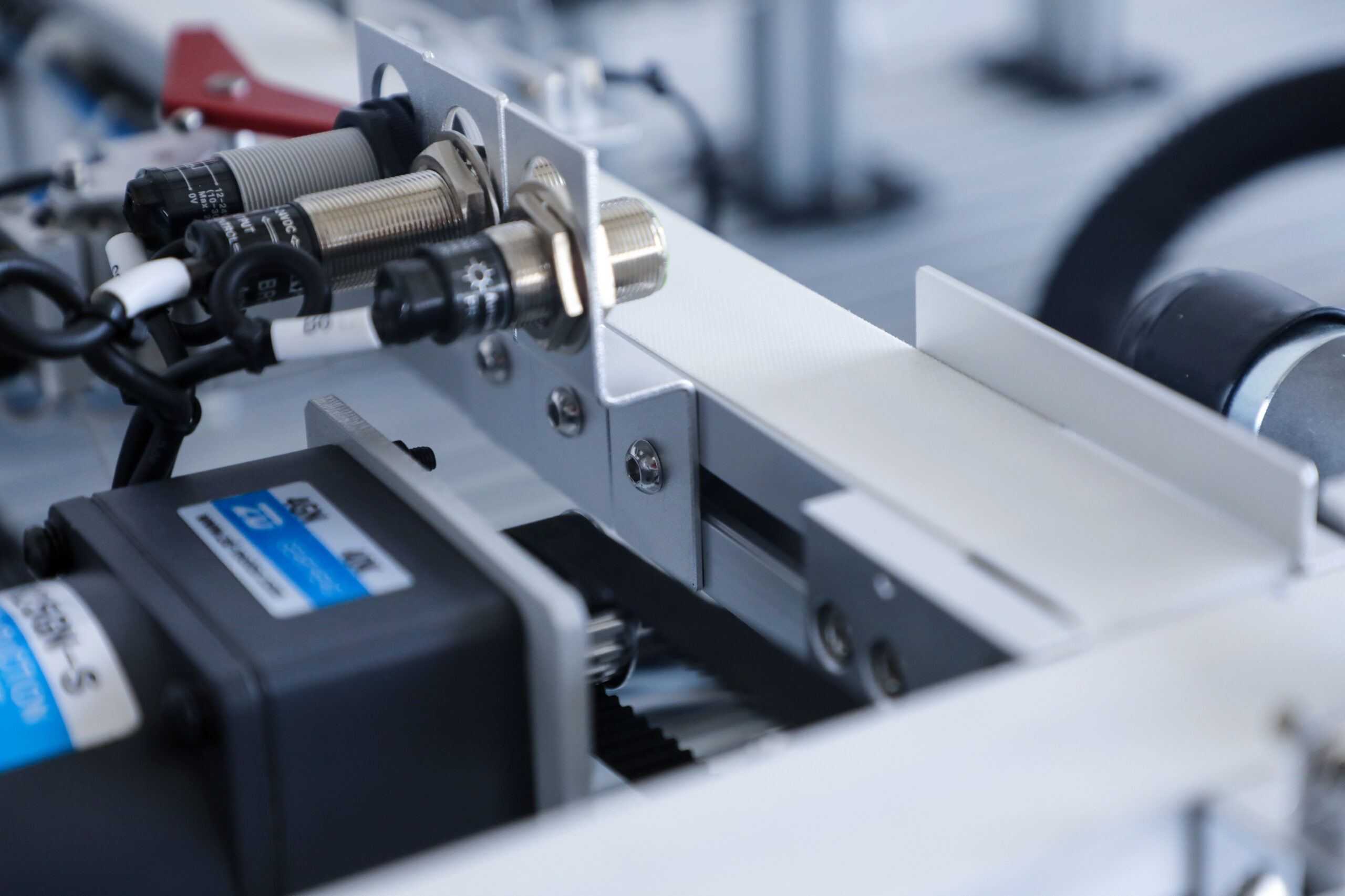
Recent years have seen some motion-components suppliers offer new servo amplifiers for edge-computing functions and so-called cabinet-free arrangements.
Why? Well, drives are often the best-instrumented components on a machine. After all, they close control loops on current, velocity, position, and more at high-frequency intervals. They’re also a suitable location for the collection of phase current, rotor position, bus voltage, and winding temperature. Yet until recently their data went unused … tossed between fieldbus cycles.
Now, certain drives with integrated logic eschew reliance on some central controller to process this data themselves. The result is communications of machine status in microseconds. Specifics depend on the industrial-Ethernet protocol, but the result is motion systems that can quickly act on data to prevent crashes, jams, and misfeeds while concurrently informing operational systems on machine status in near-realtime.
In some cases, safety functions have also migrated to edge-computing arrangements safe torque off, safe stops, and various motion limits run as certified functions on the drive. Drives then assume the tasks traditionally done by safety relays, contactors, and hardwired stop circuits.
Benefits of edge computing at the drive: Amplifiers that can execute logic and safety can in some cases be positioned on the machine and at a good distance from the machine controller and any control cabinetry. Such drives do need ruggedized housings (IP rated if the equipment is subject to challenging environmental conditions) as well as specialized hybrid cabling. But the benefits are reduced wiring, regenerative energy functions, simplified diagnostics and machine monitoring (especially powerful if the hardware is addressable), and (often most significant) a quick control response.
Use case: Edge computing for conveyance
Consider one application example for edge computing … that of an industrial conveyor. Though many conveyors today are relatively simple single-speed systems (as we’ll cover in more detail shortly) many have evolved into networked systems tracked by sensors and encoders with servodrives and motors coordinated with complementary workcell functions to manipulate and inspect conveyed workpieces.
A vast array of sensor subtypes track workpieces’ orientation, surface quality, weight, lot number, and more — all data that can enrich database records. Other sensors tasked with tracking machine-assembly conditions (such as belt tensions, bearing temperatures, and frame vibrations) populate machine-health records with data. With one fieldbus clock all these conveyor events have timestamps accurate enough to reconstruct the plant condition for any event of interest.
For operations, such edge computing can impart zero-pressure accumulation as well as gapping, merging, and diverting functions to conveyor systems. Such edge computing also supports the coordination of machine-tending tasks when multiple robotic arms interface with a single conveyor: Controls use workpiece positions and other information to command picking, sorting, labeling, or ejecting functions on the fly.
For condition monitoring of conveyors, edge computing leverages motor-torque signature analysis to identify issues such as mistracking belt sections or accumulation pressures indicating a workpiece jam developing. In contrast, increases in motor-current draw can indicate seal or bearing wear … especially when accompanied by a mechanical component’s operating temperature slowly creeping upward.
Edge computing also brings traceability to conveyor-based installations — especially important in facilities processing medical, pharmaceutical, and food products.
Edge computing in simpler motion systems
So far, we’ve emphasized advanced machine designs with fieldbuses and networked servocontrols. Of course, many single-axis and other classic machines use relay contacts, limit and proximity switches, and 4-20 mA control loops sans any deterministic Ethernet-based protocol. Here, smart edge devices can terminate binary and analog signals with local interpretation in the form of debounce, scale, threshold, timestamp, and feature-extraction functions. That way, only pre-summarized data and immediately meaningful events are sent onward … which is especially helpful when that data is going to travel over modest Ethernet or wireless connections.
Motion axes in such arrangements can include indexers based on pneumatic cylinders, VFD-driven conveyors, gearmotor-driven rollers various, and various cam-actuated mechanisms. Controls for such axes may not employ closed-loop servocontrol but still generate signals worth monitoring — especially by edge I/O. Even simple limit, home, and proximity switches can yield valuable data about strokes, cycles, and dwells … and inform monitoring systems to prompt the repair of worn components long before the machine actually jams.
Likewise, current transducers can (via 4-20 mA output) inform simple motor-current signature analyses to detect issues described above. Accelerometers on or near couplings, gearboxes, and other mechanical components can detect when peak values exceed a threshold to yield early wear trending without full spectral condition monitoring. Otherwise, VFDs (via their speed reference) can directly serve as a data-generating edge device. Then the machine diagnostics these signals communicate travel with simple open-loop.
Commercially available hardware with these capabilities include certain manufacturers’ programmable edge controllers with built-in digital and analog I/O terminals and the ability to locally run code and then publish via MQTT/OPC UA. Yet other motion suppliers’ controllers wirelessly pair with sensor nodes or discrete or analog inputs that themselves are hardwired to the machine.

Leave a Reply
You must be logged in to post a comment.