Taking the approaches of older distributed (decentralized) drive setups are cabinet-free drives.
Joaquin Ocampo · Product manager | Bosch Rexroth
Manufacturers looking to optimize operations are increasingly leveraging control technologies that can identify and address weaknesses. These emphasize digitalized connectivity for so-called digital-transformation (DX) initiatives that yield greater insights through data. But motors and drives — the heart of motion within manufacturing — have evolved, too. Now, cabinet-free drives are enabling new possibilities to let manufacturers boost machine responsiveness, flexibility, and productivity.

Cabinet-free drives are power-supplying motion components that can mount on or next to the motor on the machine. Some are rated IP65/67 to withstand dust and water exposure. They connect by one or two hybrid cables incorporating conductors for power, data, and safety signals … and not in some enclosed cabinet with its own wiring and cooling. The core idea is the same that spurred older distributed (decentralized) drive setups. Now though, drives are even more ruggedized (and cabling more standardized) for setups that often need no cabinet at all.
Cabinet-free automation for lean manufacturing
Consolidation within manufacturing has evolved from a novel concept to a requirement for many, as operators are being tasked with doing more in a smaller space. In many locations, real-estate prices have increased, prompting manufacturers to look for space-efficient equipment.
Arguably, the most important benefit of using cabinet-free drives is the space savings … especially for how it reduced the amount of cabling. When one removes a physical cabinet and the extensive cabling that’s needed with it by mounting the drive directly on the machine, it frees up a lot of room so operators can use the space more efficiently. There’s a financial benefit to reducing cabling as well as a reduced or eliminated cost on air conditioning for a smaller cabinet, or no cabinet at all. In short, manufacturers can have fewer connection points that can be prone to errors such as loose connections or faulty connections. As such, any reduction in unnecessary cabling can be a huge plus for manufacturers looking to save space to make room for more critical needs.
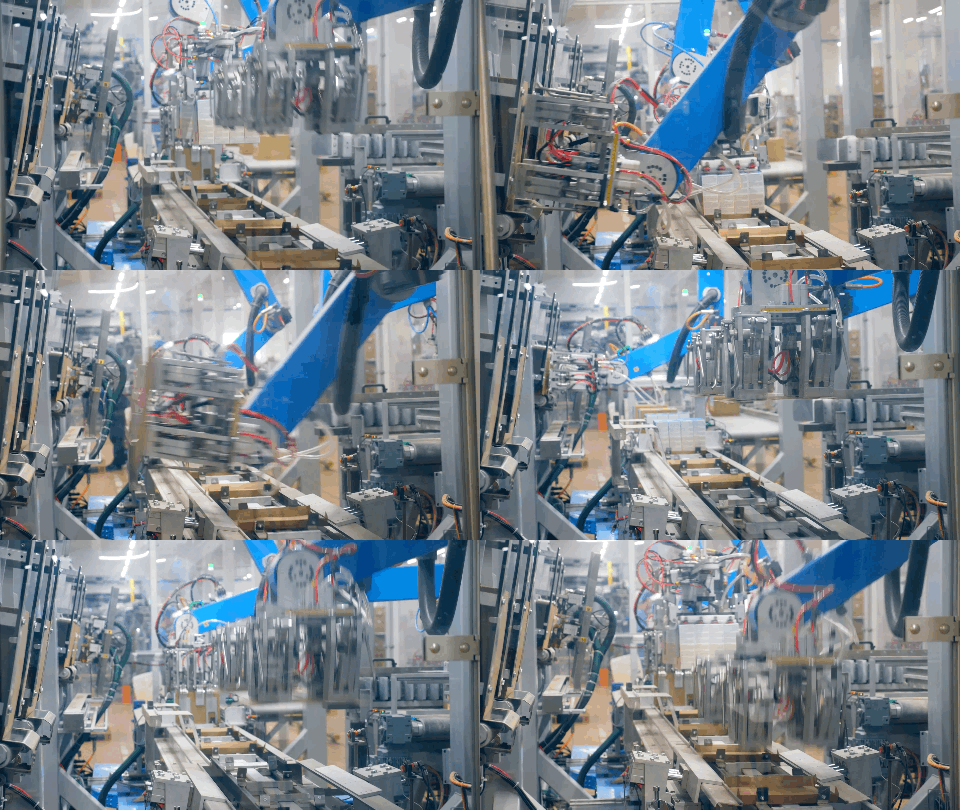
Cabinet-free automation for modularity
Another modern objective for manufacturers is flexible and scalable operations — to adjust to market shifts. Automation technologies that expedite and facilitate that shift are inherently valuable.
Traditionally, drives and cabinets have been concretely tied to a machine — it’s been an established setup designed for a singular purpose without much flexibility. If an end-user wanted to expand operations or productivity, they would often have to add an entire machine setup, which was costly and time-consuming.
Now, with more modular technology and cabinet-free drives, machines can be adjusted more easily to respond to market demands, and drives can include multiple axes on a single drive, including up to two x 30A, which more helps power multiple motors for increased productivity. Modulars can be added without the need to change the drive cabinet in a fast and efficient manner.
Cabinet-free motion components for energy savings
While perhaps not as much of a central consideration in American manufacturing as it’s in Europe, sustainability is still an important factor for many operators, especially in its direct impact on a company’s bottom line. Energy-saving technology is growing in its adoption as manufacturers look to consolidate resources, be good stewards of the environment, and ultimately operate as efficiently as possible.
This is another key benefit of using a cabinet-free approach. Traditional cabinets need consistent cooling to make sure the energy generated from motors and drives doesn’t overheat the system. When operators remove that element and decentralize their drives, that energy usage can be better managed and circulated. An important component of that is the actual semiconductors used within the drive. Silicon carbide semiconductors can significantly reduce energy losses compared to traditional IGBT technology, providing a smaller product that produces less heat.
In short, cabinet-free drives allow manufacturers to more accurately determine exactly how much power they need and where it must be placed, which helps eliminate unnecessary power usage and reduce the overall cost to operate.
Migrating to cabinet-free automation can be done gradually
Some manufacturers incrementally transition to a cabinet-free motor-drive setup. After all, it can be daunting to phase out standard and proven control-cabinet installs when productivity can’t be compromised. That’s why testing out cabinet-free setups on an isolated workcell can sometimes work best … as that lets endusers see the impact on a smaller scale before wholesale migration.
Bosch Rexroth | boschrexroth-us.com
 About the author: Joaquin Ocampo is a product manager for Bosch Rexroth. His career spans more than 25 years with the company, and he specializes in advanced drive technology with the company’s Automation and Electrification business area.

Leave a Reply
You must be logged in to post a comment.