
Worm gears are often used for their ability to provide large speed reduction and high torque multiplication. But their self-locking properties can also be beneficial in many applications.
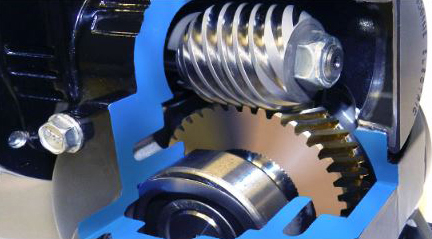
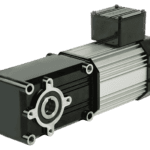
Image credit: Bodine Electric Company
In a worm gear assembly, the worm is typically the driving component. Self-locking means that the gear cannot drive the worm. In other words, back driving is not possible.
Self-locking can occur when the assembly is in either a static or a dynamic state, although it is more common when the worm gear is static – i.e. not moving. In theory, as long as the coefficient of friction between the gear and the worm is larger than the tangent of the worm’s lead angle, the worm gear is considered self-locking and will not back drive. The static coefficient of friction generally depends on the materials of the two components and any lubrication between them. But in real-world use, other factors, such as the condition of the surfaces (ground surfaces introduce less friction than rough surfaces) or the presence of external vibrations, can lower the static coefficient of friction.
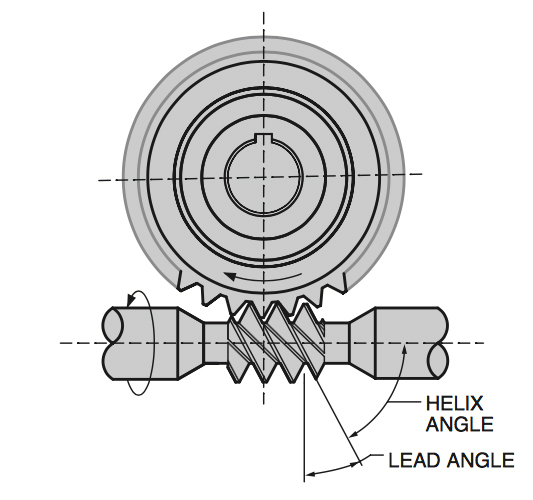
Dynamic friction is lower than static friction, and correspondingly, dynamic self-locking is less likely to occur than static self-locking for a worm gear with the same lead angle and operating conditions. In addition to the considerations mentioned above for the static coefficient of friction, the coefficient of dynamic friction is also affected by the worm gear’s rotational speed and the lubrication’s behavior under dynamic conditions.
Another way to state the condition for self-locking is that the friction angle between the worm and the gear must be larger than the worm’s lead angle. The static friction angle is the angle at which relative motion between two components (such as a block and a wedge) just begins to occur under otherwise static conditions. The dynamic friction angle is the angle that causes the motion between the two objects to cease.
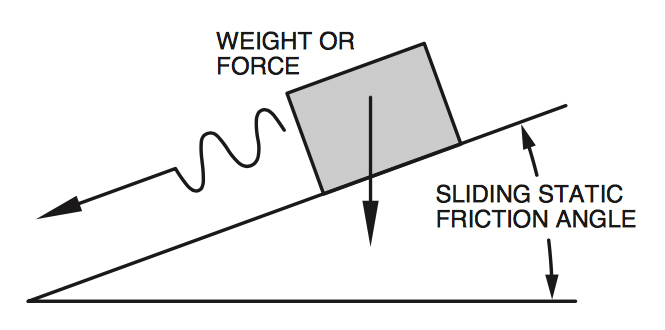
Image credit: HBD/Winsmith, Inc.
The static coefficient of friction between a steel worm and a bronze gear is approximately 0.15, which gives a friction angle of approximately 8 to 9 degrees: arctan(0.15) = 8.5 degrees.
The dynamic coefficient of friction depends on the speed of the worm gear. It can range from 0.08 at slow speeds – giving a friction angle of 4.6 degrees – to less than 0.02 at high speeds – giving a friction angle of approximately 1 degree.
Self-locking, or the prevention of back driving, is useful in applications that require lifting and/or holding loads. But the American Gear Manufacturers Association (AGMA) recommends that a brake should be used to ensure that a worm gear will not back drive, rather than relying on the worm gear’s theoretical ability to self-lock.
Feature image credit: Altra Industrial Motion Corp.



Leave a Reply
You must be logged in to post a comment.