• Skip to primary navigation
  • Skip to main content
  • Skip to primary sidebar
  • Skip to footer
  • Advertise
  • Subscribe

Motion Control Tips

Automation • Motion Control • Power Transmission

  • News
    • Industry News
    • Editor Blogs
  • Controls
    • HMIs
    • PC-Based Controllers
    • PLCs + PACs
    • Stand-Alone Controllers
    • Software
  • Drives
    • Servo Drives
    • Stepper Drives
  • Encoders
    • Absolute Encoders
    • Incremental Encoders
    • Rotary Encoders
  • Mechanical
    • Bearings
    • Brakes + Clutches
    • Belt + chain
    • Couplings
    • Gears + Gearing
    • Lubrication
    • Shock + Vibration Mitigation
    • Springs + Rings + Seals
  • Linear
    • Actuators
    • Linear Motors
    • Linear Encoders
  • Motors
    • AC Motors
    • DC Motors
    • Brushless Motors
    • Gearmotors
    • Piezo Motors
    • Servo Motors
    • Stepper Motors
  • Systems
    • Conveyors + linear transport systems
    • Gantries + Stages
    • Rotary Tables
    • Grippers + End Effectors
    • Robotics
  • Networks
    • Connections + Sliprings
    • Fieldbuses
    • I/O
    • Sensors + Vision
  • Resources
    • FAQs
      • Motion Casebook
      • Motion Selection Guides
    • Suppliers
    • Video
You are here: Home / FAQs + basics / FAQ: What’s the difference between standard and inverter-duty gearmotors?

FAQ: What’s the difference between standard and inverter-duty gearmotors?

March 24, 2017 By Miles Budimir Leave a Comment

Standard gearmotors are designed to operate over a wide range of conditions producing a range of output speed and torque. However, there are special motor designs aimed at specific applications, such as washdown motors used in food and beverage processing or explosion-proof motors used in hazardous locations. Inverter-duty gearmotors are a bit like this.

As the name implies, inverter-duty refers to a gearmotor whose speed is controlled by an inverter, or VFD (variable frequency drive). The difference between an inverter-duty gearmotor and a standard gearmotor is in the construction. These motors are specifically designed to operate at low speeds and not overheat. Because of the special way the windings are insulated, they are better able to withstand the voltage spikes of the fast-switching PWM signals generated by VFDs. The insulation will not break down and cause motor failure. Inverter-duty gearmotors can thus produce a wider constant-torque speed range than a standard gearmotor.

So, where are inverter-duty gearmotors used? The most common applications are material handling equipment, packaging equipment and conveyors. In short, any application requiring adjustable speed, hence the use of a VFD.
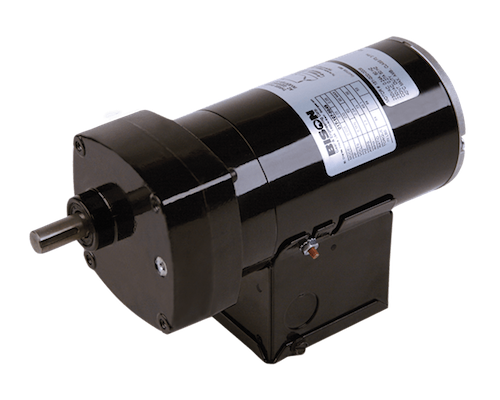

gearmotors
The 107 series of inverter-duty gearmotors from Bison Gear are typical for these types of motors, used in adjustable or controlled speed applications in material handling and packaging equipment and conveyor systems.


You might also like

Filed Under: FAQs + basics, Gearmotors

Reader Interactions

Leave a Reply

You must be logged in to post a comment.

Primary Sidebar

LEARNING CENTER

Design World Learning Center

Motion Control Handbook

“mct
EXPAND YOUR KNOWLEDGE AND STAY CONNECTED
Get the latest info on technologies, tools and strategies for Design Engineering Professionals.

RSS Featured White Papers

  • Robotic Automation is Indispensable for the Logistics Industry’s Continued Growth and Success
  • Reliable Linear Motion For Packaging Machines
  • Polymers Outperform Metals In Precision Gearing

Footer

Motion Control Tips

DESIGN WORLD NETWORK

Design World Online
The Robot Report
Coupling Tips
Linear Motion Tips
Bearing Tips
Fastener Engineering.
Wire and Cable Tips

MOTION CONTROL TIPS

Subscribe to our newsletter
Advertise with us
Contact us
About us

Copyright © 2025 · WTWH Media LLC and its licensors. All rights reserved.
The material on this site may not be reproduced, distributed, transmitted, cached or otherwise used, except with the prior written permission of WTWH Media.

Privacy Policy | RSS