• Skip to primary navigation
  • Skip to main content
  • Skip to primary sidebar
  • Skip to footer
  • Advertise
  • Subscribe

Motion Control Tips

Automation • Motion Control • Power Transmission

  • News
    • Industry News
    • Editor Blogs
  • Controls
    • HMIs
    • PC-Based Controllers
    • PLCs + PACs
    • Stand-Alone Controllers
    • Software
  • Drives
    • Servo Drives
    • Stepper Drives
  • Encoders
    • Absolute Encoders
    • Incremental Encoders
    • Rotary Encoders
  • Mechanical
    • Bearings
    • Brakes + Clutches
    • Belt + chain
    • Couplings
    • Gears + Gearing
    • Lubrication
    • Shock + Vibration Mitigation
    • Springs + Rings + Seals
  • Linear
    • Actuators
    • Linear Motors
    • Linear Encoders
  • Motors
    • AC Motors
    • DC Motors
    • Brushless Motors
    • Gearmotors
    • Piezo Motors
    • Servo Motors
    • Stepper Motors
  • Systems
    • Conveyors + linear transport systems
    • Gantries + Stages
    • Rotary Tables
    • Grippers + End Effectors
    • Robotics
  • Networks
    • Connections + Sliprings
    • Fieldbuses
    • I/O
    • Sensors + Vision
  • Resources
    • FAQs
      • Motion Casebook
      • Motion Selection Guides
    • Suppliers
    • Video

Incremental Encoders

FAQ: How do magnetic encoders work?

November 13, 2015 By Danielle Collins Leave a Comment

Magnetic Encoder

Encoders, whether rotary or linear, absolute or incremental, typically use one of two measuring principles—optical or magnetic. While optical encoders were, in the past, the primary choice for high resolution applications, improvements in magnetic encoder technology now allow them to achieve resolutions down to one micron, competing with optical technology in many applications. Magnetic technology […]

Filed Under: Absolute Encoders, Encoders, FAQs + basics, Incremental Encoders, Linear Encoders, Rotary Encoders

What are capacitive encoders and where are they suitable?

October 29, 2015 By Danielle Collins Leave a Comment

capacitive encoders

Two types of encoders dominate the general industrial market—optical and magnetic. But capacitive encoders, a relatively new introduction, offer resolution comparable to optical devices, with the ruggedness of magnetic encoders. Currently, there are only a handful of vendors for capacitive encoders, but their suitability for applications requiring high precision and durability make them a good […]

Filed Under: Absolute Encoders, Encoders, FAQs + basics, Incremental Encoders, Linear Encoders, Rotary Encoders Tagged With: cuiinc

Determining pulses per revolution for an encoder application
October 24, 2015 By Danielle Collins 1 Comment

Encoder Pulses Per Revolution

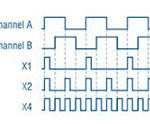
Incremental encoders determine rotary position by generating a specific number of pulses per revolution (PPR) and counting those pulses as the encoder spins. The PPR rating indicates resolution, and is typically the most important factor when selecting an incremental encoder. But how do you determine what PPR is needed for a specific application? Fortunately, establishing the required […]

Filed Under: Encoders, FAQs + basics, Incremental Encoders, Rotary Encoders Tagged With: encoder, incremental encoder, rotary encoder

Resolver versus encoder — what’s the difference?
October 9, 2015 By Danielle Collins 1 Comment

Resolver vs Encoder

Resolvers and encoders are both devices that measure the rotary position of a shaft by converting mechanical motion into an electrical signal. Resolvers have a longer history, originally used in military applications and adopted for industrial use due to their rugged design. But encoders are taking the place of resolvers in many applications. What’s driving the shift […]

Filed Under: Absolute Encoders, Encoders, FAQs + basics, Incremental Encoders, Rotary Encoders Tagged With: encoder, encoders, resolver, resolvers, rotary encoder, rotary encoders

FAQ: What do X1, X2, and X4 position encoding mean for incremental encoders?

October 1, 2015 By Danielle Collins 1 Comment

Incremental encoders

An encoder is a device that measures position, and in some configurations, can also measure direction. Rotary encoders measure rotation of a shaft, while linear encoders measure distance traveled. For both types of encoder, the position measurement can be either incremental or absolute. An incremental encoder measures change in position, but does not keep track of […]

Filed Under: Encoders, FAQs + basics, Incremental Encoders, Linear Encoders, Rotary Encoders

Linear encoder types — and parameters for selection
September 25, 2015 By Danielle Collins 3 Comments

Linear encoders

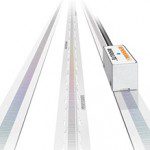
Linear encoders monitor linear movement and provide position feedback in the form of electrical signals. In servo driven systems, linear encoders supply the precise position of the load, typically in addition to the speed and direction feedback provided by the motor’s rotary encoder. For stepper driven systems, which typically operate in open-loop mode with no position […]

Filed Under: Absolute Encoders, Encoders, FAQs + basics, Incremental Encoders, Linear Encoders

Programmable Encoders: The Next Generation
August 20, 2015 By Motion Control Tips Editor Leave a Comment

traditional-magnetic-rotary-encoders

by Jarrod Orszulak, Product Manager, POSITAL-FRABA The latest programmable encoders offer both incremental and absolute functionality on one hardware platform and can be programmed with a WiFi connection. Programmable incremental encoders have become more common recently. This is largely due to the fact that the measurement characteristics of the device (number of pulses per rotation, […]

Filed Under: Absolute Encoders, Encoders, Incremental Encoders, Linear Encoders, Rotary Encoders Tagged With: Posital-Fraba

FAQ: What are ways to wire an incremental encoder into a motion system?
July 6, 2015 By Zak Khan Leave a Comment

Incremental Encoder Single-Ended Wiring

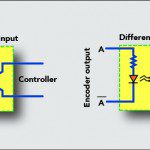
There are two ways to wire an incremental encoder into a system. One is single-ended wiring and the other is differential wiring. In single-ended wiring, each channel needs only one wire. Channels are any data streams that the encoder produces. For example, a common quadrature encoder has two channels—A and B—to track speed as well […]

Filed Under: DC Motors, Encoders, Incremental Encoders, Motors, Stepper Motors

  • « Go to Previous Page
  • Page 1
  • Page 2
  • Page 3
  • Page 4

Primary Sidebar

LEARNING CENTER

Design World Learning Center

Motion Control Handbook

“mct
EXPAND YOUR KNOWLEDGE AND STAY CONNECTED
Get the latest info on technologies, tools and strategies for Design Engineering Professionals.

RSS Featured White Papers

  • Robotic Automation is Indispensable for the Logistics Industry’s Continued Growth and Success
  • Reliable Linear Motion For Packaging Machines
  • Polymers Outperform Metals In Precision Gearing

Footer

Motion Control Tips

DESIGN WORLD NETWORK

Design World Online
The Robot Report
Coupling Tips
Linear Motion Tips
Bearing Tips
Fastener Engineering.
Wire and Cable Tips

MOTION CONTROL TIPS

Subscribe to our newsletter
Advertise with us
Contact us
About us

Copyright © 2025 · WTWH Media LLC and its licensors. All rights reserved.
The material on this site may not be reproduced, distributed, transmitted, cached or otherwise used, except with the prior written permission of WTWH Media.

Privacy Policy | RSS