• Skip to primary navigation
  • Skip to main content
  • Skip to primary sidebar
  • Skip to footer
  • Advertise
  • Subscribe

Motion Control Tips

Automation • Motion Control • Power Transmission

  • News
    • Industry News
    • Editor Blogs
  • Controls
    • HMIs
    • PC-Based Controllers
    • PLCs + PACs
    • Stand-Alone Controllers
    • Software
  • Drives
    • Servo Drives
    • Stepper Drives
  • Encoders
    • Absolute Encoders
    • Incremental Encoders
    • Rotary Encoders
  • Mechanical
    • Bearings
    • Brakes + Clutches
    • Belt + chain
    • Couplings
    • Gears + Gearing
    • Lubrication
    • Shock + Vibration Mitigation
    • Springs + Rings + Seals
  • Linear
    • Actuators
    • Linear Motors
    • Linear Encoders
  • Motors
    • AC Motors
    • DC Motors
    • Brushless Motors
    • Gearmotors
    • Piezo Motors
    • Servo Motors
    • Stepper Motors
  • Systems
    • Conveyors + linear transport systems
    • Gantries + Stages
    • Rotary Tables
    • Grippers + End Effectors
    • Robotics
  • Networks
    • Connections + Sliprings
    • Fieldbuses
    • I/O
    • Sensors + Vision
  • Resources
    • FAQs
      • Motion Casebook
      • Motion Selection Guides
    • Suppliers
    • Video
You are here: Home / FAQs + basics / FAQ: What is stepper drive idle-current reduction and why does it help?

FAQ: What is stepper drive idle-current reduction and why does it help?

August 15, 2016 By Zak Khan Leave a Comment

When stepper motors operate, they operate by drawing current continuously. This method of operation ensures more accurate positioning and more consistent torque. However, this also means an increase of energy they use and the amount of heat they produce. This holds true even when the stepper motor is idling.

Idling is not a very efficient operating mode for stepper motors or drives. This because the drive is supplying current, and the stepper motor is consuming it, but nothing is moving. Such unnecessary current draw wastes electricity and increases operating costs. Ideally, the motor would switch off whenever rotation is not occurring. However, this has its own set of drawbacks.

Recall that stepper motors usually must ramp up and down from its start and stop positions. If this is not done the stepper motor may skip or stall. As such, the motor cannot simply “switch off and on” it must accelerate and decelerate at the proper rates.

Idling current means the motor is still responsive. To reduce energy consumption yet still ensure positioning accuracy, the drive can supply far less current during idling than what it supplies regular operating conditions. That way the system can avoid some of the ramping up and down.
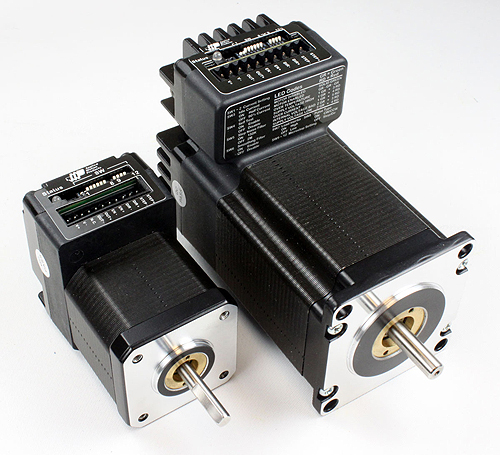
These are integrated drive and stepper motor units from Applied Motion that use idle-current reduction.


Idle-current reduction usually reduces the current sent from the drive anywhere from zero to 100 percent depending on how the drive’s configuration. Some drives can drop the supply of current automatically after a set period of no rotation. Manufacturers of drives that include idle current reduction list these values and thresholds in their motor’s documentation. Make sure that a drive’s current reduction technique and the amount of reduction is compatible with your system. Extended periods of no activity mean the motor is best switched off rather than changed to idling current while shorter periods of no activity are best for idling current.

For more information on idle-current reduction, read …

Applied Motion Products: 3540M – DC Microstep Drive
You might also like

Filed Under: Drives + Supplies, FAQs + basics, Stepper Drives

Reader Interactions

Leave a Reply

You must be logged in to post a comment.

Primary Sidebar

LEARNING CENTER

Design World Learning Center

Motion Control Handbook

“mct
EXPAND YOUR KNOWLEDGE AND STAY CONNECTED
Get the latest info on technologies, tools and strategies for Design Engineering Professionals.

RSS Featured White Papers

  • Robotic Automation is Indispensable for the Logistics Industry’s Continued Growth and Success
  • Reliable Linear Motion For Packaging Machines
  • Polymers Outperform Metals In Precision Gearing

Footer

Motion Control Tips

DESIGN WORLD NETWORK

Design World Online
The Robot Report
Coupling Tips
Linear Motion Tips
Bearing Tips
Fastener Engineering.
Wire and Cable Tips

MOTION CONTROL TIPS

Subscribe to our newsletter
Advertise with us
Contact us
About us

Copyright © 2025 · WTWH Media LLC and its licensors. All rights reserved.
The material on this site may not be reproduced, distributed, transmitted, cached or otherwise used, except with the prior written permission of WTWH Media.

Privacy Policy | RSS