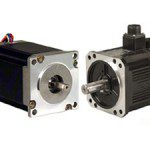
Servo and stepper motors have similar construction and share the same fundamental operating principle. Both motor types incorporate a rotor with permanent magnets and a stator with coiled windings … and both are operated by energizing or applying a dc voltage to the stator windings, which then causes the rotor to move. However, this is […]
Stepper Motors
FAQ: What are lead-lag stepper motor controls?
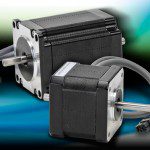
Lead-lag controls or compensators are pieces of programming in control systems that improve frequency response. A lead control can increase a system’s stability or its response speed. A lag control can reduce steady-state errors. Different combinations change output in different ways. A note on terminology: The terms controller and compensator have several different meanings. Some […]
FAQ: What is closed-loop control with load-position control?

Load-position control is a form of closed-loop stepper-motor control. It’s true that stepper motors can run open loop—as they don’t need sensor-feedback-based controller corrections. So, stepper-motor circuits are simpler and the motors are easy to implement … but if anything goes wrong in the application, the open-loop stepper won’t respond to the new condition. In […]
FAQ: How to pick between stepper motor, brush dc, and brushless motors?
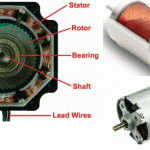
When choosing a motor for an application, consider key differences between each motor’s operation. Stepper motors: Performance positioning Stepper motors work for precise positioning and control with torque. Intermittent moves is what steppers output best. Tip: Don’t use stepper motors for continuous operation. When applications need motors to operate nonstop, steppers exhibit dwindling efficiency and […]
Smaller, more flexible stepper motors from Kollmorgen

Kollmorgen introduces its new generation of stepper motors, the PMX series, adding smaller 08, 11, and 14 frame sizes to the traditional 17, 23 and 34 frame size offering. Thanks to a wider range of sizes and options, OEMs now have added flexibility to meet multiple performance and application needs from a single motion source. […]
FAQ: What’s the difference between variable-reluctance linear and hybrid linear steppers?
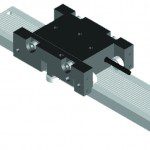
Linear motors come in different mechanical and electromechanical arrangements to satisfy the requirements of different applications. For example, brushless linear motors (capable of forces to 2,600 N or more) work well in heavy robotics or material-handing applications. Linear ac-induction motors output 2,000 N to satisfy heavy-conveyor parameters. In contrast, iron-core brushless linear motors deliver a […]
FAQ: How do linear stepper motors compare to familiar rotary types?
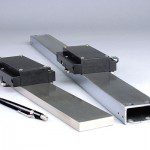
Stepper motors go into linear actuators in two different ways: Stepper motors that are traditional rotary motors couple to mechanical rotary-to-linear motion devices (often in the form of a threaded shaft that mates with traversing nut or carriage) to produce linear motion. In this actuator setup, the motor output shaft usually couples to the screw […]
FAQ: What is the difference between absolute and incremental encoders?

Rotary encoders track speed and position. Absolute and incremental encoders both do this, but operate differently and have different methods of implementation. Rotary incremental encoders work by generating a series of pulses during movement. The encoder disc (sporting marks or slots) attaches to a power-transmission shaft, and a stationary pickup device mounts nearby. When the […]
FAQ: What are ways to wire an incremental encoder into a motion system?
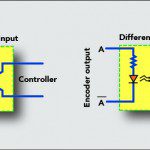
There are two ways to wire an incremental encoder into a system. One is single-ended wiring and the other is differential wiring. In single-ended wiring, each channel needs only one wire. Channels are any data streams that the encoder produces. For example, a common quadrature encoder has two channels—A and B—to track speed as well […]
FAQ: What do DIP switches on stepper drives do, and what are alternatives?
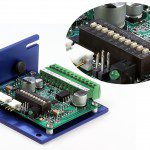
Dual in-line package or DIP switches are manual electronic switches that, along with other switches in one package, form one unit. They usually mount on printed circuit boards through pins. Some common types of DIP switches include rotary, slider and rocker switches. Through them, end users configure circuit boards or controllers for the application at […]