
Beckhoff unveils a compact servo technology solution

Beckhoff Automation (www.beckhoff.com) has introduced a compact servo technology solution with the release of the EL7201 servo terminal for the EtherCAT Terminal system. This 12 mm terminal offers a complete servo drive suitable for motors up to 200 W. Its integration into the EtherCAT I/O system effectively reduces costs and cabinet size requirements, while simplifying commissioning and cabling.

The new EL7201 servo terminal with resolver interfaces offers high servo performance in an exceptionally compact design. In addition, its integrated fast EtherCAT control technology, with PI speed control and field-oriented current, can support highly dynamic positioning tasks. Aside from the direct connection of a resolver and motor, a motor holding brake connection is also possible.

“The new EL7201 servo terminal is a true game-changer in the area of servo technology,” remarked Graham Harris, President, Beckhoff Automation.

“Small servo drives have been a popular technology for years and the EL7201 is a major evolution of this trend. Machine builders and manufacturers now have the option to control small servos with a 12 mm device.”

Permanent magnet synchronous motors, featuring a rated current of up to four A, can be connected to the new terminal as loads.

Beckhoff EL7201 servo terminal

The new servo terminal provides maximum operational reliability, as it monitors various parameters, including undervoltage and overvoltage, overcurrent, motor load or terminal temperature.

Since it is fully integrated into Beckhoff’s TwinCAT automation software, the EL7201 servo terminal allows convenient parameterization. For third-party masters, parameterization occurs through the CAN over EtherCAT profile (CoE).

maxon’s brushless servo motor suitable for use in extremely harsh conditions

Maxon Motor’s (www.maxonmotor.com) has launched the EC 22 HD (Heavy Duty), which is a standard motor suitable for use in harsh ambient conditions. Specifically designed to meet the deep drilling technology’s exceptionally high requirements, the electronically commutated motor EC 22 HD can withstand even the most extreme operating conditions.

Offered in different variants, the new EC 22 HD are developed for operation in use in air or submerged in oil. Its assigned power rating relies on the surrounding medium and averages 240 Watts in oil and 80 Watts in air. Designed to cope with ambient temperature of over 200°C (390°F), the servo motor can also withstand atmospheric pressures of up to 1’700 bar (25’000 psi).

EC 22 HD standard motor

Its 22 mm diameter motors can withstand impact and impulse of up to 100 G and vibration of up to 25 grms. Featuring high efficiency — that is up to 88 percent in air and more than 70 percent in oil — the motors provide the best prerequisite for battery-based applications. The motor possess excellent regulation behavior as it offers a detent-free running characteristics, making it ideally suited for high-precision positioning tasks, even at low speeds.

The new EC 22 HD unveils new possibilities in various applications that demand for equally high requirements. Thus, the motor is not only well-prepared for use in space technology, but in power plants, aircraft industry, vehicle manufacturing and in mining as well.

What are Integrated Servomotors?

A newer subcategory of servomotor is often called the integrated servomotor. In this type of design, the motor itself is combined with the other essential components of a complete motion control system including the feedback device (generally an encoder), the amplifier or motor drive, a communication port and the motion controller itself.

Such systems are said to offer greater reliability mainly because there are fewer parts to connect together. Also, fewer external connections means less cabling and wiring. Less cabling and wiring reduces costs, as does the fact that the components that one would usually purchase separately such as the motion controller and the drive are integrated into one package.

These integrated servomotors are also designed to be programmed easily and quickly, which can help reduce development times. Communication options range from simple serial communication links such as RS232 or RS485 to more advanced network topologies suited to complex motion control tasks such as CANopen, DeviceNet, or Ethernet protocols.

integrated servomotor

As with any motor, when selecting an integrated servomotor for an application, the most important step is determining the characteristics of the load. This is why properly calculating the load torque is such an important part of selecting the right motor and designing it into the application. A good rule of thumb to keep in mind is to try and keep the actual operating conditions below the published limits of the motor in order to ensure reliable and long-life operation.

Motor sizing parameters are usually based on the torque curve and moment of inertia of the load. These two factors can help determine the motor’s operating bandwidth. Sets of torque curves depict limits of both continuous and peak torque for the given motor over their full range speed.

There are different types of torque curves, dealing with peak torque and continuous torque as well. Peak torque curves can be derived from dyno testing and represent the point at which peak current limit hardware settings of the drive prevent further torque in an effort to protect drive stage components.

For any mechanical system, if the motor is operating in its optimum range, then the system will be performing at its best. Beyond the motor itself, depending on the specifics of the application it may be necessary to adjust mechanical components such as gear reducers, belts, lead screw pitch or pinion gears in order to achieve optimal system performance.

What is a Servomotor?

Nailing down precisely what a servomotor is can be a tricky exercise, but basically the hallmark of any servomotor is the presence of feedback and closed-loop control. Servomotors are able to provide precise control of torque, speed or position using closed-loop feedback. They also have the ability to operate at zero speed while maintaining enough torque to maintain a load in a given position. Servomotors have several distinct advantages over other types of motors. For starters, they offer more precise control of motion. This means they can accommodate complex motion patterns and profiles more readily. Also, because the level of precision offered is high, the position error is greatly reduced.

All servomotors have essentially three components; an electric motor, a feedback device, and some type of electronic control.

The electric motor itself can be either an ac or a dc motor. Under the dc heading, brushed dc servomotors are generally less expensive than brushless servos, but do require more maintenance due to the brushes needed for motor commutation.

Servomotor

Brushless servomotors are more expensive than brushed dc motors. Generally, these are used in applications requiring higher torque. Brushless dc servomotors are highly reliable and virtually maintenance free. However, the drives for brushless dc servomotors are more complex because the commutation is done electronically rather than mechanically as in the brushed dc motor.

Another way to classify servomotors can be as either single-phase or three-phase motors. Motors of the single-phase variety can range from the simple and inexpensive brushed dc motors mentioned above to voice coils for small micro- and nano-positioning applications.

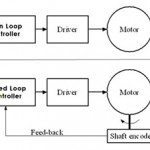
Servomotors also require a form of feedback, often with the feedback device, such as an encoder, built right into the motor frame. The feedback signal is needed by the control circuitry to close the control loop. It is this closed-loop control that gives servomotors their precise positioning ability.

Lastly, the control circuitry typically involves a motion controller, which generates the motion profile for the motor, and a motor drive which supplies power to the motor based on the commands from the motion controller.

Servomotors are used in many different industrial applications from machine tools, packaging machinery, communications and robotics applications to newer applications such as solar panel control and a broad range of automation control applications. The diversity of applications means that servomotors are designed for general-purpose indoor environments but also for specialized situations requiring them to withstand extreme temperatures and pressures outdoors as well as the special demands of food processing industries in washdown environments.

What is a Servo Controller?

More specific types of controllers, such as servo controllers, are used to control servomotors. When dealing with servo systems, it’s important to note that definitions for servomotor, servo system, and servo controllers can differ widely throughout industry. When selecting a servo system for an application, it’s best to ask suppliers what exactly their offerings entail.

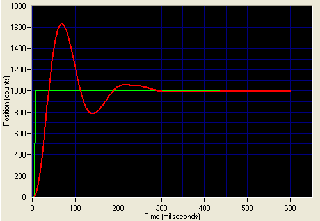
A servo controller is the heart of a servo system. A typical servo system consists of a motor, feedback device, and the controller. The control circuitry typically involves a motion controller, which generates the motion profile for the motor, and a motor drive which supplies power to the motor based on the commands from the motion controller. Servo systems are closed-loop systems which have some benefits over open-loop systems including the fact that they improve transient response times, reduce steady state errors and reduce system sensitivity to load parameters.

Servo controllers perform two types of tasks; tracking some commanded input and improving a system’s disturbance rejection. One of the most powerful methods of control is PID control, which stands for proportional-integral-derivative control. PID control is a combination of proportional control, integral control and derivative control. A PID control method works on the error signal which is the difference between a commanded value and the actual value of an output variable, and driving the error to zero. The proportional value can be thought of as a simple gain value. The integral value integrates the error over a period of time and helps to drive the error to zero. The derivative value helps to stabilize a system that uses an integral and proportional term only.

There are a few important factors to consider when selecting a servo controller for an application. The first thing is knowing which type of motor is to be controlled. Is the servomotor an ac or dc motor? If dc, is it brushless or brushed? This will help in determining the kind of commutation the motor needs and if the controller can accommodate it.

How many axes of motion does the application have? Is it a single axis of control or are there multiple axes? Servo controllers are available to control simple single axis applications as well as more complex motion such as robotics applications involving multiple axes.

Next, how many channels of I/O are needed? Are special input types needed beyond inputs for feedback signals such as speed and position? Be sure that the controller can accommodate the appropriate feedback device, such as incremental encoder signals, resolver signals, SSI, Hall sensor signals, or tachometer inputs.

Another important factor that is sometimes overlooked is the controller set up. Is the controller easy to set up and program? Is programming done via keypad or can it be programmed from a computer screen? Also consider the available communication links. Are there basic RS232 or RS485 links? Does the controller include bus interfaces for common networks such as CAN, DeviceNet, Sercos or Ethernet?

Hiperface DSL encoder interface simplifies servomotor connection

Sick (www.sick.com), a German encoder manufacturer, has unveiled a new digital interface technology that simplifies servomotor connection — the Hiperface DSL (digital servo link) encoder interface.

Sick Hiperface DSL encoder interface

The new interface enables one cable to carry both encoder signal and power. Motors now require a single connector only, which significantly reduces costs and cabling time.

For safe speed and position functions, the Hiperface DSL encoder interface has been specifically designed to be the only interface that supports encoders to SIL3 levels.

Using two or four wires within a motor’s power cable, digital sensor data can be transmitted on a maximum distance of 100 m. Although commonly used for motor winding temperature sensors, the twisted-wire pair wires can now be utilized for digital communications. Encoders compatible with the new protocol are provided with an optional input which digitize temperature signals and transmit them directly to the drive containing the encoder data.

Standard cables can be used when transmitting data at a distance of up to 20 m. For longer distances, the cables must conform to specified impedance criteria.

Offering a transmission rate of 9.216 Mbd, the new interface conforms with RS-485 criteria. It transmits data in a short span of 12.15 μs, or five times faster than the fastest drives.

“The combination of improved speed regulation and functionality with greater operator safety, and at a reduced cost, marks a significant step forward,” said Darren Pratt, encoder specialist at Sick UK.

“Hiperface DSL is set to be the new standard for high- to low-performance applications.”

The new encoders can also be used to log speed, temperature and rotation data for maintenance purposes. Hiperface DSL can also include other sensor information — such as vibration, acceleration and torque — to offer optimized dynamic control.

Siemens offers new high-inertia 1FK7-HI servo motors

Siemens Industry, Inc. (www.sea.siemens.com) has unveiled its expanded 1FK7 servomotor family that features a new high-inertia style. The design’s higher rotor inertia makes the control response of the latest 1FK7-HI servo motors highly robust and ideal for variable- and high-load inertia applications, such as auxiliary and feed axes on machine tools, as well as unwinders and winders on packaging, printing and converting equipment.

High Inertia Servomotors

The self-cooled 1FK7-HI servomotors offer stall torque in the 3Nm to 20Nm range and are offered in IP65 or IP64 with IP67 protective flange degree, with selectable options for keyed or plain shaft, 22-bit absolute or incremental encoders, as well as 18 color options.

Its mechanical decoupler located between the encoder shaft and motor protects the encoder from mechanical vibrations to provide a long service life. In case the encoder needs to be exchanged, the tool automatically aligns the encoder signal into the rotor pole position to enable feedbacks to be changed at the field in less than five minutes.

The new Siemens 1FK7-HI servo motors also have a unique Drive-Cliq serial bus and electronic nameplate recognition to allow virtual plug-and-play operation when paired with the Sinamics S drive platform. Every servo motor in this new family is also configured to interface with the motion controller Simotion for general motion control use and Siemens Sinumerik CNC technology for machine tool applications.

FAULHABER Expands BX4 Series Motors

The BX4 Series from FAULHABER has been expanded by twelve new 32mm Brushless DC-Servomotors. The features of the BX4 line are long operational lifetime, a high cogging-free output torque and no adhesive bonded joints. This makes them ideal for many applications like robotics, automation, medical, machinery, aerospace and aviation. The new BX4 series brushless motors are available in two lengths of 42 or 68 mm and in 12 or 24 V windings. The BX4 demonstrates excellent linearity with an impressive torque-to-volume ratio and provides a continuous output torque of 56 or 97 mNm.

BX4 Series from FAULHABER%202%20

Besides FAULHABER’s wide array of external control electronics, the BX4 series is now available with an integrated Speed Controller (SC) version, a typical +/- terminal (SCDC) version and an integrated Motion Controller (CS) version. All products with integrated electronics are equipped with current limiting capabilities (peak and continuous) to provide extra protection your motor and electronics. All BX4 models are reversible and a separate power supply is now available upon request.

The SCDC version of the BX4 has redefined simplicity. With only a dual terminal power supply connection on the back of the motor (typical +/- configuration), it can easily replace brushed type motors in applications demanding greater longevity. Furthermore, the SSDC version includes built-in reverse polarity protection.

The CS version, based on FAULHABER Motion Control Systems, has compact dimensions that benefit space constrained applications. It contains an RS232 serial interface and can be configured with FAULHABER’s downloadable Motion Manager software. The increased temperature range from -20 to +100 °C and the higher thermal limits allowing a continuous current of to 2.6A increase the versatility of the BX4 line (available with custom firmware upon request).

An integrated encoder, now offered in a robust housing, is available in four factory programmable resolutions from 32, 64, 128 to 256 pulses plus an index channel. A line driver version with differential signal output is now available upon request.

FAULHABER
www.faulhaber.com