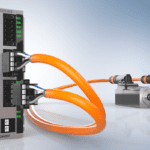
The new ELM72xx EtherCAT Terminals from Beckhoff are fully functional servo drives in a robust metal housing that deliver an output current (Irms) of up to 16 A at 48 V dc for the power supply. They expand the company’s portfolio of compact drive technology in I/O terminal format and offer all of the current […]
Servo Drives
Multi-axis servo system features oversampling technology
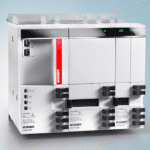
The AX8000 multi-axis servo system from Beckhoff now offers oversampling technology in addition to extremely high dynamics and μsec cycle times. Oversampling technology via EtherCAT enables process data scans several times within a communication cycle. This significantly boosts performance for precision processing machines and other systems that require evaluation of high-resolution measured values. With the […]
New sensor technology for servo components helps deter line downs and optimize machine uptime
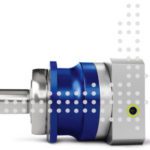
WITTENSTEIN SE has launched a new sensor technology, cynapse, designed as a new self-monitoring gearbox with built-in tracking of vibration, temperature, acceleration and mounting position of the gearbox. Designed to promote machine uptime and deter line downs, the high-precision servo gearbox with cynapse sensor technology consists of three significant features: Product Identification: The gearbox features […]
Servo drive modules from Trinamic handle up to 1,000 W
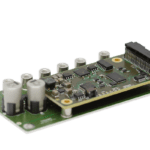
TRINAMIC Motion Control, now part of Maxim Integrated, has released the TMCM-1636, a single-axis servo controller, developed for drives up to 1,000 W and 60 A RMS. It’s suited for robotics, lab and factory automation, manufacturing, and patient handling equipment such as motorized beds and chairs. The new module achieves high-current loop frequencies that minimize […]
What’s the difference between torque mode and velocity mode in servo control?
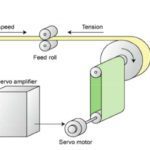
Servo systems are used when the application calls for precise control of position, velocity, or torque — or a combination of the three. Depending on the parameter being controlled, the servo system can be operated in torque mode, velocity mode, or position mode. Each mode requires control loops that allow the servo drive and controller […]
Trinamic introduces small, lightweight servo controller module

TRINAMIC Motion Control introduces the TMCM-1617, single-axis servo controller module, designed for servo drives with 18A RMS and 8 to 28V dc supply voltage. The TMCM-1617’s EtherCAT, CAN and RS485 interfaces, ultra-lightweight aluminum housing (conforms with DIN EN 60529), and a cutting-edge feature set make the TMCM-1617 an ideal choice for medical, aerospace, and robotics. […]
New series of servo products from Mitsubishi Electric Automation

Mitsubishi Electric Automation, Inc. has released its next generation MELSERVO-J5 Series of ac servo motors, amplifiers, and motion control units. The MELSERVO-J5 Series brings performance, reliability, flexibility and efficiency to a wide range of industries, including manufacturing, packaging, printing, converting, material handling and more. MELSERVO-J5 is a result of continuous innovation and improvement upon the […]
Motion system design: Can a servo-driven machine be too stiff?
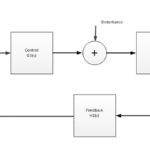
When we think of stiffness, we often think of mechanical stiffness — the ability of a part or system to resist deflection. But in servo-driven motion systems, stiffness can also refer to how the system is tuned — that is, how the gains in the servo controller are set and, correspondingly, how the motor responds […]
Servo amplifier with multi-network interface from Mitsubishi Electric

The MR-J4 servo amplifier series from Mitsubishi Electric incorporates a multi-network interface called “Servo Open Network”. It enables the user-friendly drive to be compatible with all relevant motion control systems worldwide. Machine manufacturers who offer their solutions globally will benefit from the open network connection feature of the MELSERVO MR-J4 amplifier series. Communications is simplified […]
What is a motor choke and why is it used?
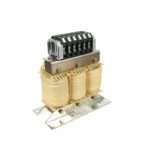
A choke is a passive device that adds inductance to a circuit. Inductance is a property of a coil of wire that resists any change to the current flowing through it. (Straight wires also possess a small amount of inductance.) In other words, if current through the coil increases, the magnetic field of the coil […]