
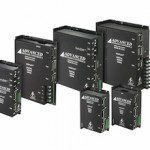
Advanced Motion Controls (AMC) offers a full range of servo drives and amplifiers. Servo drives are an essential part of motion control systems, and AMC servos are an excellent foundation for high performance. Currently, AMC offers hundreds of standard servo drive and amplifier models that accept various command signals, communicate over several networks and operate in […]
Servo Drives
Kollmorgen’s latest servo drive broadens range of power and industrial fieldbus options
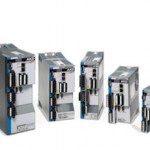
Kollmorgen’s new 32-kW drive is one of the most power dense on the market, consuming only 576 cm2 of panel space; the smallest drive in the AKD® family, at 1 kW, consumes only 99 cm2. The AKD platform is one of the highest performing on the market, with a 0.67 µsec current loop, approximately 100x […]
New ANG Active Next Generation Servo Inverter Series
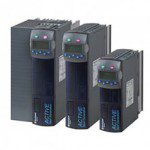
Bonfiglioli Riduttori S.p.A., a global designer and manufacturer of gearmotors, drive systems and planetary gearboxes, announces the addition of a servo inverter series, ANG Active Next Generation, which provides higher performance for machine builders. With this new servo inverter series, Bonfiglioli offers the broadest connectivity with the most advanced control technology and the highest power […]
What’s the difference between servo and closed-loop stepper motors?
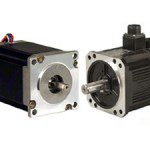
Servo and stepper motors have similar construction and share the same fundamental operating principle. Both motor types incorporate a rotor with permanent magnets and a stator with coiled windings … and both are operated by energizing or applying a dc voltage to the stator windings, which then causes the rotor to move. However, this is […]
Astonishingly small servo drive survives HALT for guaranteed life
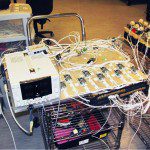
One family of motor drives — tiny ultra-high-current Gold Bee drives from Elmo Motion Control — recently passed highly accelerated life testing (HALT) for accelerated temperatures, electrical cycles, thermal shocks and vibrations. The tests show that the small servo drive successfully withstands temperatures from -75° to +110° C and easily endures mechanical vibrations exceeding 30 […]
How clean power, shared bus make motion drives efficient

The following is an article from Elmo Motion Control that explains how some of their drives work and how that translates to better efficiency. Machine builders always try to boost throughput while keeping a lid on costs. The best way to reach this goal is through the use of machine control capable of high dynamics and high-accuracy, generally […]
Sub-nm moves from dual-axis EtherCAT PWM servo drives
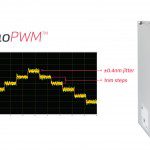
ACS Motion Control now sells a NPMPM Series EtherCAT pulse-width-modulation (PWM) servo drives. They deliver the accuracy of linear drives without their drawbacks. The PWM servo drives are significantly smaller, much more efficient, produce less heat dissipation, better protected and lower in cost. More after the jump. An optional 10-MHz laser encoder interface and a control algorithm lets positioning systems get speeds above 2 […]
Beckhoff compact multi-axis servo system with high maximum control speeds, fast installation

The new Beckhoff AX8000 multi-axis servo system, with a compact form factor for space-saving control cabinet installation, enables high-precision positioning and machining processes with extremely short control cycles. Additional features include fast installation and commissioning by simply plugging together the desired axis modules, as well as One Cable Technology (OCT) and the direct integration of […]
Spectral Decomposition for fast servo control from Delta Tau
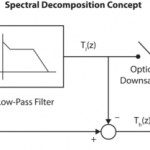
Delta Tau now offers a new control method called Spectral Decomposition to improve the productivity of systems that use fast-tool actuators. Spectral Decomposition works with a variety of fast-tool actuators—including voice-coil motors, piezo crystals, laser galvanometers and magnetostrictive transducers. These actuators have high bandwidth, but limited travel. So they are typically paired with a standard […]
Machine Tool Trends: more safety and distributed control
by Miles Budimir, Senior Editor for Design World— Machine tools almost naturally keep pace with advances in motion control, because they’re basically highly precise motion control systems involving accurate and precise positioning. Advances in networking and computing power of controllers have led to better machine tool performance and added functionality in areas such as safety, […]