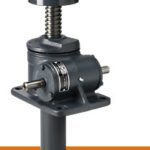
Jackscrews (also referred to as jack screws or screw jacks) are among several different kinds of linear motion actuators most often used for lifting or moving loads. They can also be used in any application needing linear motion, or where pushing or pulling along a linear axis is needed. Other common mechanical actuators include lead, […]
Mechanical PT
New servo actuators feature dual absolute encoder, panel mount connectors
Harmonic Drive has introduced new dual absolute encoder versions of the FHA-C mini actuator featuring BiSS-C bi-directional communication for both encoders. The dual encoders are incorporated in essentially the same package size as the long-standing FHA-C mini single incremental encoder version. Without increasing the size, the dual absolute encoder offers single-turn absolute position at the […]
New Marland BCMA backstop now has an automatic lubrication system
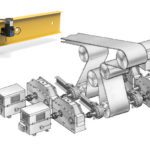
Marland Clutch now offers an automatic grease lubrication system that eliminates the need to manually grease the labyrinth seals of its Marland BCMA backstops. In many instances, Marland BCMA backstops are located in difficult-to-reach areas making regular grease maintenance very difficult. By installing the new automatic lubrication system, regular grease maintenance is performed, but no […]
Why use a gearbox with a stepper motor?
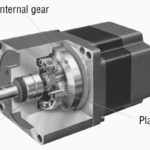
Stepper motors are known for their accurate positioning capabilities and high torque delivery at low speeds, but they require careful sizing to ensure the motor matches the load and application parameters, to minimize the possibility of lost steps or motor stalling. Adding a gearbox to a stepper motor system can improve the motor’s performance by […]
Oil-shear technology clutch/brakes from Force Control eliminate maintenance, adjustment
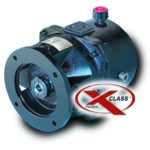
Force Control Industries presents their Posidyne X Class Clutch Brakes which feature Oil Shear technology that allows rapid and precise stopping, starting, reversing, speed change and positioning – all without adjustment and virtually no maintenance. Well suited for applications with frequent start/stop cycles, these unique motion control devices allow higher cycle rates (as high as […]
Strain-wave gears and other components in off-highway + mobile robotics
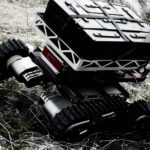
Automated mobile equipment, which transports items in warehouses and freight centers as well as assembly operations, continues to boost demand for power-transmission and motion control systems. In fact, the worldwide mobile-robot market will reach nearly $15 billion by 2026, according to researchandmarkets.com. Almost all run off electric-motor drivetrains that are relatively expensive upfront but with […]
What are negative-stiffness vibration isolators?
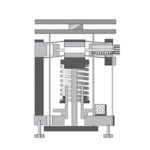
Protecting sensitive equipment from harmful vibrations can be done with either passive or active isolation systems, with the choice often being made on price, simplicity, and the level of protection required. Although passive systems are typically simpler and lower cost, most passive designs can’t protect against the low-frequency vibrations caused by structural resonances. And active […]
Vibration damping: What’s the difference between passive and active methods?
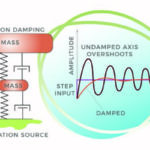
Unlike typical static or dynamic loads, forces due to vibrations are difficult to predict, model, and account for when designing motion control systems. Some manufacturers recommend adding a safety factor to account for vibrations when sizing and selecting components — especially those that involve rolling or sliding motion, such as linear guides and screws. Of […]
Drives and controls for robotics: See them at the 2019 Robotics Summit
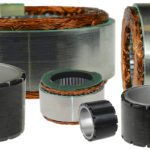
In a couple weeks, the 2019 Robotics Summit (focused on the design, development, manufacture, and delivery of commercial robotics) will take place in Boston. It will be co-located with the DeviceTalks event at the Seaport World Trade Center. One display will be an array of precision processing and powering technologies for robotics. Elmo Motion Control […]
Using mechanical torque limiters to protect servo-driven machinery
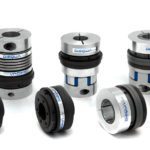
Servomotor-driven machinery abounds in today’s automated applications. These designs typically require high speeds for top throughput, dynamic operation for nimble positioning, and (in many cases) quick reversals for indexing. So it’s key to have some means to: Protect the servomotor from damage by sudden load changes, over-torque conditions, or shock due to machine issues. The […]