• Skip to primary navigation
  • Skip to main content
  • Skip to primary sidebar
  • Skip to footer
  • Advertise
  • Subscribe

Motion Control Tips

Automation • Motion Control • Power Transmission

  • News
    • Industry News
    • Editor Blogs
  • Controls
    • HMIs
    • PC-Based Controllers
    • PLCs + PACs
    • Stand-Alone Controllers
    • Software
  • Drives
    • Servo Drives
    • Stepper Drives
  • Encoders
    • Absolute Encoders
    • Incremental Encoders
    • Rotary Encoders
  • Mechanical
    • Bearings
    • Brakes + Clutches
    • Belt + chain
    • Couplings
    • Gears + Gearing
    • Lubrication
    • Shock + Vibration Mitigation
    • Springs + Rings + Seals
  • Linear
    • Actuators
    • Linear Motors
    • Linear Encoders
  • Motors
    • AC Motors
    • DC Motors
    • Brushless Motors
    • Gearmotors
    • Piezo Motors
    • Servo Motors
    • Stepper Motors
  • Systems
    • Conveyors + linear transport systems
    • Gantries + Stages
    • Rotary Tables
    • Grippers + End Effectors
    • Robotics
  • Networks
    • Connections + Sliprings
    • Fieldbuses
    • I/O
    • Sensors + Vision
  • Resources
    • FAQs
      • Motion Casebook
      • Motion Selection Guides
    • Suppliers
    • Video

Danielle Collins

What’s the relationship between current and dc motor output torque?

December 23, 2015 By Danielle Collins Leave a Comment

DC motor

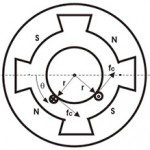
Torque is a rotational force produced when a vertical force is applied at some distance from the center axis of the rotating body. The familiar equation for torque is: Where: T = torque F = applied vertical force d = distance from axis of rotation In a DC motor, the output torque is directly proportional to the […]

Filed Under: DC Motors, FAQs + basics, Motors Tagged With: current, DC motor, torque, torque calculation

What’s the difference between BLDC and synchronous AC motors?
December 17, 2015 By Danielle Collins Leave a Comment

BLDC and synchronous AC motors

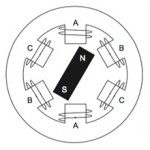
The short answer is: brushless DC (BLDC) and synchronous AC motors are similar in construction and operation. Some manufacturers and experts even group them together as similar technologies, in the category of  “permanent magnet synchronous motors.” Their key difference, however, lies in the stator coil windings and resulting back-EMF waveform of each motor. This gives them distinct performance […]

Filed Under: DC Motors, FAQs + basics, Motors, Servo Motors, Stepper Motors Tagged With: bldc motor, brushless motor, permanent magnet motor, synchronous motor

Pull-Up Resistor Basics

December 10, 2015 By Danielle Collins Leave a Comment

pull-up resistors

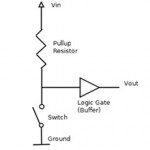
To understand a pull-up resistor, it helps to first understand how encoder output is generated. Incremental encoders can provide several types of digital output, with the three primary types being open collector, push-pull, and line driver. Open collector output is considered sinking, while the line driver type is considered sourcing, and push-pull output is both […]

Filed Under: Encoders, FAQs + basics, Incremental Encoders Tagged With: encoder, encoder output, incremental encoder, pull-up resistor, resistor

The relationship between voltage and dc motor output speed
December 6, 2015 By Danielle Collins Leave a Comment

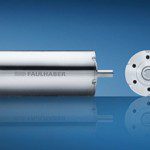
The operation of a DC motor is relatively straightforward. A coil is placed in a magnetic field, and when an electric current passes through the coil, a torque is produced, causing the motor to turn. The entire process is driven by applying electrical power to the coil, with the source voltage having a direct relationship […]

Filed Under: DC Motors, FAQs + basics, Motors Tagged With: DC motor, motor, speed

Ways to wire an absolute encoder into a motion system

November 19, 2015 By Danielle Collins 1 Comment

wire an absolute encoder

Absolute encoders are traditionally wired in one of three ways: in parallel, with a serial interface, or over a bus. The serial and bus interfaces have multiple protocols or standards, some of which are open-source, while others are proprietary to specific manufacturers. When considering how to wire an absolute encoder, the required resolution, level of […]

Filed Under: Absolute Encoders, Encoders, FAQs + basics, Linear Encoders, Rotary Encoders

FAQ: How do magnetic encoders work?

November 13, 2015 By Danielle Collins Leave a Comment

Magnetic Encoder

Encoders, whether rotary or linear, absolute or incremental, typically use one of two measuring principles—optical or magnetic. While optical encoders were, in the past, the primary choice for high resolution applications, improvements in magnetic encoder technology now allow them to achieve resolutions down to one micron, competing with optical technology in many applications. Magnetic technology […]

Filed Under: Absolute Encoders, Encoders, FAQs + basics, Incremental Encoders, Linear Encoders, Rotary Encoders

FAQ: What are stacked piezo actuators and what do they do?
November 5, 2015 By Danielle Collins Leave a Comment

stacked piezo actuators

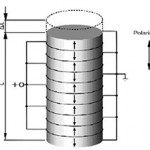
A piezo element is a ceramic that expands or contracts when an electrical charge is applied, generating linear movement and force. Multiple piezo elements can be layered on top of each other, creating what is known as a stacked piezo actuator. These devices take advantage of the combined effect of each element’s expansion to produce a useful […]

Filed Under: Actuators, FAQs + basics, Piezo Motors

What are capacitive encoders and where are they suitable?

October 29, 2015 By Danielle Collins Leave a Comment

capacitive encoders

Two types of encoders dominate the general industrial market—optical and magnetic. But capacitive encoders, a relatively new introduction, offer resolution comparable to optical devices, with the ruggedness of magnetic encoders. Currently, there are only a handful of vendors for capacitive encoders, but their suitability for applications requiring high precision and durability make them a good […]

Filed Under: Absolute Encoders, Encoders, FAQs + basics, Incremental Encoders, Linear Encoders, Rotary Encoders Tagged With: cuiinc

Determining pulses per revolution for an encoder application
October 24, 2015 By Danielle Collins 1 Comment

Encoder Pulses Per Revolution

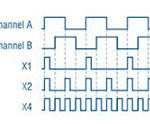
Incremental encoders determine rotary position by generating a specific number of pulses per revolution (PPR) and counting those pulses as the encoder spins. The PPR rating indicates resolution, and is typically the most important factor when selecting an incremental encoder. But how do you determine what PPR is needed for a specific application? Fortunately, establishing the required […]

Filed Under: Encoders, FAQs + basics, Incremental Encoders, Rotary Encoders Tagged With: encoder, incremental encoder, rotary encoder

FAQ: What’s the difference between single and multi-turn rotary encoders?
October 15, 2015 By Danielle Collins Leave a Comment

rotary encoder

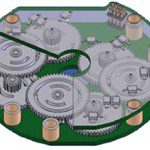
Absolute rotary encoders output precise position information—even after a power-off condition—by assigning a unique digital value, or “word,” to each shaft position. But in applications where the encoder makes more than one revolution during the process, there is no way to know how many turns it has completed. At least not with the traditional type […]

Filed Under: Absolute Encoders, Encoders, FAQs + basics, Rotary Encoders Tagged With: encoder, multi-turn, rotary encoder, single-turn

  • « Go to Previous Page
  • Page 1
  • Interim pages omitted …
  • Page 31
  • Page 32
  • Page 33
  • Page 34
  • Go to Next Page »

Primary Sidebar

LEARNING CENTER

Design World Learning Center

Motion Control Handbook

“mct
EXPAND YOUR KNOWLEDGE AND STAY CONNECTED
Get the latest info on technologies, tools and strategies for Design Engineering Professionals.

RSS Featured White Papers

  • Robotic Automation is Indispensable for the Logistics Industry’s Continued Growth and Success
  • Reliable Linear Motion For Packaging Machines
  • Polymers Outperform Metals In Precision Gearing

Footer

Motion Control Tips

DESIGN WORLD NETWORK

Design World Online
The Robot Report
Coupling Tips
Linear Motion Tips
Bearing Tips
Fastener Engineering.
Wire and Cable Tips

MOTION CONTROL TIPS

Subscribe to our newsletter
Advertise with us
Contact us
About us

Copyright © 2026 · WTWH Media LLC and its licensors. All rights reserved.
The material on this site may not be reproduced, distributed, transmitted, cached or otherwise used, except with the prior written permission of WTWH Media.

Privacy Policy | RSS