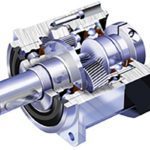
Updated 2020 ⚙️ Gearboxes provide torque multiplication, speed reduction, and inertia matching for motor-driven systems. Servo systems, specifically, require gearboxes that can supply not only high torque with low added inertia, but also high precision and stiffness. One type of gearbox meets all these criteria while providing relatively long operating life with low maintenance requirements […]
What You Need to Know About Plastic Gears
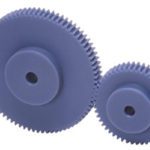
Plastic gears are primarily recognized for their quiet operation and resistance to rust – attributes that are important in the food processing, medical equipment, and chemical processing industries, as well as in consumer applications. But plastic gears offer many other benefits, and advances in materials and manufacturing processes are helping to close the remaining performance […]
Gearmotors on the move: Driving AGVs

When someone uses the term “driverless vehicle,” what probably comes to mind is some iteration of the driverless cars that auto manufacturers and technology companies have been testing for the past few years. But driverless vehicles have been around since the 1950s, when wire-guided vehicles, now known as “AGVs,” were first used for industrial applications. […]
What’s unique about worm gear lubrication?
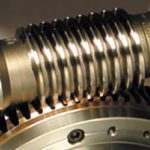
Worm gears are used in various types of applications for their ability to provide very high reduction ratios and, in many cases, for their self-locking properties. But choosing the right worm gear lubrication involves more than just selecting the right viscosity. Most gear types, such as helical, bevel and spur, experience both sliding and rolling […]
What are the best methods for gearbox lubrication?
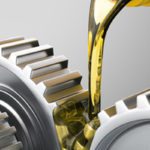
Like other types of rotating equipment, gearboxes rely on lubrication to reduce friction and provide cooling for optimal operation and life. Gearbox manufacturers provide recommendations for the type of lubrication to be used and the typical lubrication intervals, but the actual gearbox lubrication requirements depend on the environmental conditions the gearbox is exposed to, whether […]
When are worm gears self-locking, and where is this useful?

Worm gears are often used for their ability to provide large speed reduction and high torque multiplication. But their self-locking properties can also be beneficial in many applications. In a worm gear assembly, the worm is typically the driving component. Self-locking means that the gear cannot drive the worm. In other words, back driving is […]
Helical gears: What are they and where are they used?
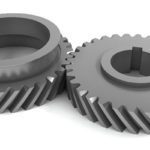
Helical gears and spur gears are two of the most common gear types and can be used in many of the same applications. Spur gears are simple and inexpensive to manufacture, but helical gears offer some important advantages over spur gears. The teeth of a helical gear are set at an angle (relative to axis […]
What are the drawbacks to using a planetary gearbox?
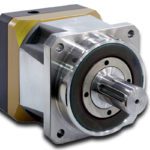
One type of gearbox meets all the design criteria of servo applications while providing relatively long operating life with low maintenance requirements — the planetary gearbox. That’s because planetary gearboxes offer high torque transmission with good stiffness and low noise in a footprint that’s more compact than that of other gearbox types. Read more about how […]
Spur gears: What are they and where are they used?
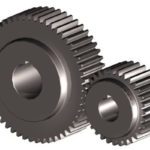
Spur gears are a type of cylindrical gear, with shafts that are parallel and coplanar, and teeth that are straight and oriented parallel to the shafts. They’re arguably the simplest and most common type of gear – easy to manufacture and suitable for a wide range of applications. The teeth of a spur gear have […]
What is pitch line velocity and why is it important?

In gearbox sizing, it’s important to determine the required input speed in rpm and ensure that it doesn’t exceed the gearbox’s maximum speed capability. But the linear velocity of the gear teeth, known as pitch line velocity, also plays a significant role in gearbox performance. Pitch line velocity is measured at the pitch line of […]